Get Full Government Meeting Transcripts, Videos, & Alerts Forever!
Get email alerts on the Executive Power topic
No spam. Unsubscribe anytime.
Florida governor outlines expansive use of executive power to enforce policy priorities
Summary
A Florida governor described how he used executive tools — from the line‑item veto to suspending local officials and coordinating immigration enforcement — to advance policy goals, citing budget savings, court fights over redistricting and education reforms.
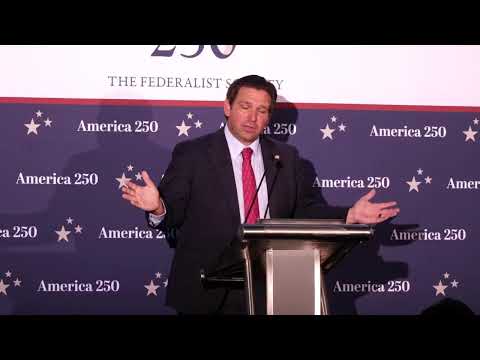
A Florida governor spent an hour detailing how he has used executive authority to pursue policy priorities, from trimming the state budget and retiring debt to disciplining local officials and coordinating immigration enforcement.
Speaking at a public forum, the governor said he compiled a ‘binder’ of constitutional, statutory and customary authorities when he took office so he could identify every lever available. He credited frequent use of the line‑item veto with enabling debt retirement and building reserves, saying “about $10 billion” in vetoes over seven years and a single‑year veto tally near $3.3 billion helped produce surpluses and a larger rainy‑day fund.
The governor said the office’s removal power over local elected officials — sheriffs and state attorneys — is a key accountability tool. He recounted removing a Broward County sheriff after the Parkland school shooting and defended suspensions of some prosecutors whom he characterized as releasing dangerous defendants; those actions, he said, changed behavior among local officials even when they were independently elected.
He described calling a special legislative session to require state and local law enforcement to assist federal immigration authorities, saying the state staged operations that interdicted migrants at sea and helped repatriate people who otherwise could have been released. The governor said Florida’s operations accounted for roughly “20 to 25,000” interdictions handled by state vessels, and he described rejecting some federal funds that imposed conditions he declined to accept.
On courts and judges, he described appointing appeals and Supreme Court judges from nominating lists and said state judicial appointments have shifted Florida’s courts toward a more conservative composition. On redistricting, he said he vetoed a map he described as a racial gerrymander, called a special session to redraw districts ahead of a Supreme Court decision and expects to defend the changes in litigation; he framed the move as consistent with constitutional limits on race‑based districting and the Voting Rights Act’s purpose.
The governor also detailed education and institutional reforms. He said the state has prioritized workforce and vocational training, maintained low in‑state tuition and expanded scholarship programs. He described changes to tenure review and hiring practices at public universities to reduce what he called political activism by faculty, and he said the state limited the role of professional organizations such as the American Bar Association in legal education.
On pandemic policy, he recounted issuing executive orders in 2020 to require schools to open for in‑person instruction and to limit masking for young children, noting the state lost in trial court but later won on appeal in litigation over those orders. He said he used clemency and commutation in selected local cases to counter local enforcement of COVID restrictions.
The governor closed by urging other executives to be bold in using their powers when voters demand action. He said he and his staff work with sympathetic governors in several states to share practices, and he described a suite of cultural and civic programs — monuments, essay contests and scholarships — tied to civic education.
The session included a brief question period; the governor left to return to official duties in Florida.