Get Full Government Meeting Transcripts, Videos, & Alerts Forever!
Get email alerts on the Fire Department topic
No spam. Unsubscribe anytime.
Torrington debate centers on $365,000 overtime to staff donated East Side firehouse
Summary
City and public safety officials debated restoring $365,000 in overtime to staff daytime coverage at a donated East Side firehouse as a stopgap to improve slow response times; supporters cited multiple medical calls and response delays, while critics pressed for a written plan, union approvals and alternatives such as moving an engine or adding ambulances.
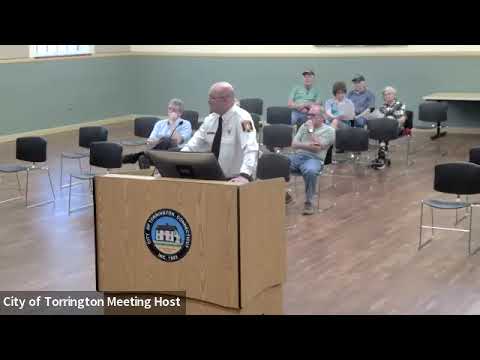
The Board of Public Safety and city council spent the bulk of their May 18 joint meeting arguing over a $365,000 overtime line added back into the fire department’s FY2026–27 budget to provide daytime staffing at the East Side firehouse donated to the city.
Chief Tripp, who presented the department’s budget, called the overtime a short-term remedy to persistent response-time gaps on the East Side. “This is the best option…to get our feet up there and start pushing data and actually making a difference to East Side residents,” he said, explaining the hours would cover the busiest daytime window and allow the department to compile response metrics while pursuing federal grant funding to staff the house full time.
Supporters argued the donated building, apparatus and accounts represent a time‑limited opportunity. Resident and public commenter Jim Potter told the council the volunteer company contributed more than $1 million in assets and that the requested overtime was a modest ask to improve response times for medical and other calls.
Opponents on the Board of Public Safety and some council members urged caution without a full plan and union sign‑offs. Commissioner Benedetto said she had reviewed planning and building records and found no completed renovations or permits; she warned the move “throws money at something just to put overtime up” without a plan, and questioned safety if a three‑person engine must respond to a structure fire.
Chief Tripp and other commissioners acknowledged the ideal long‑term staffing model is a four‑person engine on a 24/7 basis and that a SAFER grant would be sought to support that. Tripp described immediate work underway to make the donated station safe for daytime staffing — removing an old heater, adding an exhaust system and erecting a partition — and estimated facilities work at under $100,000.
Board members flagged contractual constraints: Tripp said collective‑bargaining terms now keep two engines at headquarters and one at North End unless an MOU is negotiated, making relocation of an existing company difficult without agreement. The chief argued the overtime approach was the least costly near‑term path and could be reversed if union talks failed.
Several commissioners also warned of budget consequences. Commissioner Benedetto and others noted cuts already made elsewhere (notably police) and asked where recurring costs would be found next year if overtime grew into permanent staffing. The budget subcommittee had recommended cutting the overtime line; the Board of Public Safety voted 4–2 to put it back in the Board’s recommended budget for council consideration.
The board and council did not take a final council vote on the fire budget at the meeting; participants agreed the next steps include a written plan, contractor estimates, union outreach, and continued pursuit of grant funding. Chief Tripp said he would present mapping and a fuller operations plan to the council next month.
The discussion included multiple public speakers who live on the East Side urging funding for improved response times. Resident Sharon Wagner told the council she supports police and fire funding and said commercial growth on the East Side has changed the city’s traffic and public‑safety needs.
The Board’s debate underscored a broader budget tradeoff running through the night: commissioners and council members repeatedly balanced immediate public‑safety needs against longer‑term fiscal constraints and the city’s limited ability to add recurring staff without raising revenue or winning grant awards.