Get Full Government Meeting Transcripts, Videos, & Alerts Forever!
Get email alerts on the Budget Overview topic
No spam. Unsubscribe anytime.
Finance commission reviews FY 2026–27 “path to sustainability” budget; approves March report
Summary
The South Pasadena Finance Commission on May 14 received the proposed FY 2026–27 budget emphasizing one-time reserve transfers to establish internal service funds, a customer success center, and preparations for development-driven costs; the commission approved the March 2026 monthly budget report and asked staff for clearer fund reconciliations and visual changes before council review.
The South Pasadena Finance Commission on May 14 heard a full presentation of the proposed fiscal year 2026–27 budget, described by staff as a “path to sustainability,” and approved the March 2026 monthly budget report.
Nick, the assistant city manager and chief financial officer, told commissioners the budget responds to three main cost pressures: recent labor compensation adjustments, newly recognized internal service charges (liability, workers’ compensation, facility maintenance and fleet), and deteriorating streets and sidewalks. He said staff balanced the general fund with projected revenues and operating expenditures of $45.7 million and proposed one-time transfers and reserve uses to address structural shortfalls.
Why it matters: Staff emphasized one-time transfers totaling $3.7 million to establish or shore up three internal service funds — a self-insurance fund, a facility maintenance fund and a vehicle replacement fund — and recommended embedding recurring internal service charges in department budgets to sustain those funds going forward. Nick said the proposals preserve an unassigned general fund reserve of about $14.3 million, roughly 31% of operating expenditures and about $2.9 million above the council’s 25% policy minimum.
Commissioners pressed staff on protections for those one-time transfers and on a $1.5 million designation labeled for “fiscal findings.” Nick and another staff member explained the designation acts as a precautionary cushion against possible future audit adjustments or misclassified grant expenditures and said future councils retain discretion to reallocate reserves. A staff member added that recent work to reconcile special funds and grants has already revealed legacy accounting surprises and that part of the designation is an acknowledgement of ongoing cleanup.
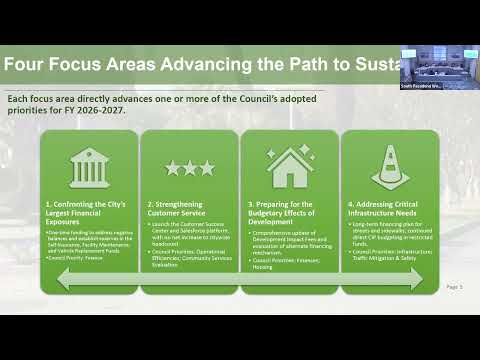
What staff proposed and how departments responded: The proposed budget outlines four focus areas — setting internal service fund reserves, launching a customer success center, preparing for development-related fiscal impacts (including a development impact fee update), and addressing critical infrastructure — and pairs the overview with department work plans.
- Customer service: Staff described a customer success center that will be led by a customer solutions manager and staffed by three transferred representatives (no net new headcount). The center will use a Salesforce-based platform to route resident requests and report performance.
- Capital program: The capital improvement program includes 24 projects across nine categories totaling about $51 million in combined carryover and new funding. Two large projects highlighted were the Huntington–Fremont corridor (about $40 million) and the Fair Oaks ITS project (about $10 million), both primarily funded by former 710 Freeway funds.
- Departments: Department directors summarized adjustments and efficiencies. Library Director Matthew Patzell outlined a $2.8 million library budget and operational changes including RFID implementation and a planned “library of things” collection. Public safety leaders said recruitment and staffing improvements reduced vacancy rates; Police Chief Derek Elmore and Division Chief Daniel Dunn (fire) described grants and equipment upgrades, including a grant-funded radio/911 modernization and a power-loading gurney. Public Works Director Julian Lee reported more accurate allocation of labor costs to special funds and progress on design for the Huntington–Fremont project. Community development and services directors described SB 79 implementation work, ADU preapproved plans, and program delivery figures for senior and youth services.
Questions and next steps: Commissioners asked for clearer reconciliation showing the true effects on the general fund versus special and internal funds, and requested improved slide visuals (color coding to distinguish savings from added costs). Staff said they will finalize a CIP book for public posting, provide reconciliations to show funding sources, and return to a joint finance commission/city council meeting on June 10 and council review on June 3.
Motion and administrative action: Early in the meeting the commission approved the consent calendar and voted to approve Item 4, the March 2026 monthly budget report. No detailed roll-call vote by name was recorded in the transcript; the chair announced the motion carried.
The finance commission adjourned at 8:27 p.m. with instructions that staff prepare a refined packet for the upcoming council study session and joint meeting.