Get Full Government Meeting Transcripts, Videos, & Alerts Forever!
Get email alerts on the Fire Assessment topic
No spam. Unsubscribe anytime.
Dunedin commission directs staff to prepare RFP for potential fire assessment amid looming property‑tax cuts
Summary
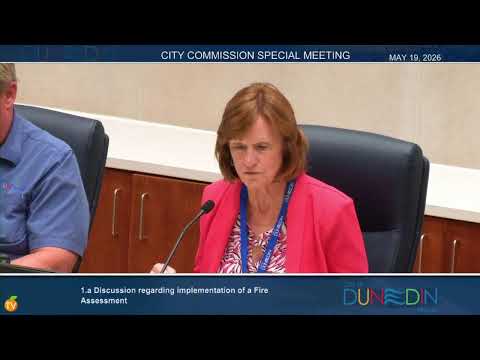
At a May 19 special meeting, Dunedin commissioners heard a legal and technical briefing on fire special assessments and gave staff consensus direction to finish an RFP for a methodology consultant; staff said adoption timelines would depend on statutory notice deadlines and possible state tax changes.
The Dunedin City Commission on May 19 heard a detailed presentation from outside counsel Chris Rowe on how a citywide fire special assessment would work and instructed city staff to finish a request for proposals for a methodology consultant and return with the draft in June.
City Manager Jennifer Bramley told commissioners the special meeting was scheduled to assemble all five members with legal counsel and emphasized that “there is not a sense of urgency” about adopting an assessment now; staff framed the study as a precautionary revenue option as several state bills could cut ad valorem revenue by about $9 million to the city.
Rowe, who said he specializes in special‑assessment law, told the commission there are three primary legal considerations that govern assessments—“special benefit to property,” fair apportionment and due process—and cautioned that courts have overturned programs found to be arbitrary. He gave commissioners two commonly used allocation methods: the demand method (allocating costs based on historical calls for service) and the availability, or readiness‑to‑serve, method (a two‑tier approach based on improvement value plus a flat per‑parcel charge).
“EMS can’t be funded with a special assessment,” Rowe said, noting courts treat advanced life‑support and other EMS services as benefits to individuals rather than to property. That means methodology consultants and staff would need to identify and exclude EMS‑related costs before allocating the remaining fire‑service costs to property owners.
Rowe explained collection options and timing: direct billing can be used at any time but has lower collection rates, while including the assessment on the annual tax bill achieves much higher collection but requires the city to adopt a short resolution by December 2026 to begin tax‑bill collection on the November 2027 tax bill. He also described common exemptions (for example, nonprofits and churches), startup and annual administrative costs, and the advantage of having a methodology report and an assessment roll to defend the program if challenged.
Commissioners questioned administrative workload, equity for low‑income and elderly homeowners, mutual‑aid responses outside city limits, and how rates would be calculated for different property classes (single‑family, multifamily, commercial). Rowe and City Manager Bramley said methodology consultants typically prepare the assessment roll and can handle much of the technical work; Bramley named Nicole Delphine as the city project manager and said finance and fire leadership would be involved.
During the meeting there was no public comment on the record. Commissioners—while acknowledging political sensitivity and affordability concerns—expressed support for proceeding slowly and involving the public. Vice Mayor (speaker 7) said, “I’m in favor of this,” Commissioner Sandberg said he would “definitely support it going forward,” and other commissioners said they wanted broad public engagement and multiple touchpoints before any final action.
Next steps: staff will finish the RFP for a methodology consultant, include a communications plan and public‑engagement schedule, and bring the RFP to the commission (target: June). No ordinance, resolution or vote to levy an assessment was taken at the meeting.
The commission adjourned after the consensus direction was recorded.