Get Full Government Meeting Transcripts, Videos, & Alerts Forever!
Get email alerts on the Municipal Finance topic
No spam. Unsubscribe anytime.
North St. Paul projects modest 2026 budget savings; fiber fund remains long-term liability
Summary
Finance Director Dan Wieck told the North St. Paul City Council the city expects modest general-fund savings this year and improvements across most enterprise funds, but the fiber-optic fund carries a roughly $1.9 million deficit that will take decades to erase without new revenue or transfers.
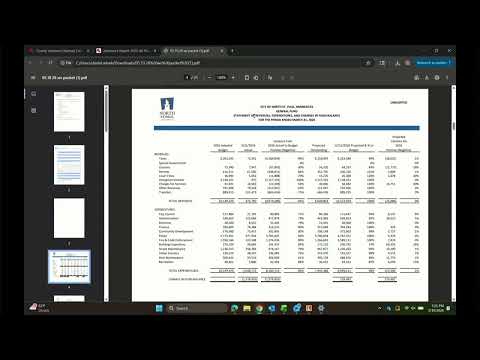
Finance Director Dan Wieck told the North St. Paul City Council that the city’s first-quarter 2026 finances are broadly on track, with the general fund roughly matching the adopted $10.1 million budget and conservative projections pointing to at least $130,000 in year-end savings.
Wieck said the city had expended a little over $2 million by the end of the first quarter and currently projects general-fund revenues about $26,000 below the adopted estimate, a gap he described as manageable under conservative assumptions. “Bottom line is we’re going to pretty much meet the revenue that we estimated and budgeted for in the 2026 budget,” Wieck said.
The finance director credited stronger staffing levels — the police department, for example, has only one vacancy — with reducing prior salary savings and bringing operations closer to budgeted personnel costs. He also noted a timing issue: county-authorized extensions to property-tax payments have delayed some distributions, but the city’s 67% fund balance provides ample cushion against short-term cash disruptions.
Across enterprise funds Wieck reported mixed results: he projected the water fund to end roughly $216,000 favorable (about $240,000 positive accounting for other items), wastewater to be about $90,000 better than budgeted, and the electric fund to show a material net-position improvement versus budget. Surface-water results are improved from budget projections but still negative; solid-waste operations have been running down a prior fund balance while staff pursues a new contract expected to be presented in June that could lower resident rates.
On the city’s fiber-optic fund — the largest structural deficit discussed — Wieck said the balance is roughly $1.9 million in advance/loan liabilities. He traced the deficit to long-running revenue attrition: state and library contracts that once supported the utility have expired, and the system was never widely commercialized. “It’s a negative fund. There’s a plan. It’s just a long plan,” Wieck said, adding that transferring cash from other funds would require council direction and likely offers limited benefit to long-term bond metrics.
Council members pressed whether the city should aggressively pay down the fiber deficit. Wieck and staff said a large interfund transfer would reduce the negative balance but would not necessarily improve long-term financing more than maintaining the city’s current reserve policy; the city’s consistent 50% fund-balance policy and recent performance were credited for a stronger bond-rating outcome.
Other items raised during the update included the county assessor’s 2026 report, which Wieck said shows a modest 1.2% median residential value decrease in North Saint Paul (the first residential decline in several years) and some commercial gains; and a forthcoming recommendation on the solid-waste RFP after staff interviews with two finalists.
The council did not take formal action on the budget presentation during the meeting; staff said several items from the update will appear on future agendas or consent items for formal approval.