Get Full Government Meeting Transcripts, Videos, & Alerts Forever!
Get email alerts on the Housing Trust Fund topic
No spam. Unsubscribe anytime.
Kansas City opens Round 6 Housing Trust Fund RFP with $15M available; applications due May 15
Summary
Kansas City’s Housing Trust Fund Round 6 will award up to $15 million. Division manager Evan Shirelli outlined eligibility, Submittable online submissions (no paper), technical assistance through May 11 and a firm deadline of May 15, 2026 at 4:59 p.m. Central.
Evan Shirelli, division manager for local initiatives at the Kansas City Housing and Community Development Department, outlined the Round 6 Affordable Housing Trust Fund request for proposals and key deadlines for applicants.
"For this round, we have up to $15,000,000 available," Shirelli said, adding that applications must be submitted online through Submittable. The application window runs March 30 through May 15, 2026, and the portal will close at 4:59 p.m. Central on May 15. Shirelli said staff will not accept paper or late applications and will offer technical assistance by appointment through May 11 at housingtrustfund@kcmo.org.
The Housing Trust Fund’s primary capital source is a $50 million general obligation bond voters approved in 2022. Shirelli said the Fund has already invested roughly $46 million in projects that have created or preserved nearly 3,000 affordable units and more than 3,500 total housing units across Kansas City. He cited recent projects supported by the Fund, including Forest Hill Village (18 transitional units by Synergy Services), The Maybion (57 permanent affordable units at 27th and Olive), a Habitat for Humanity single‑family house produced with trust fund assistance, and Amethyst Place’s Tracy Campus Expansion (32 units of permanent supportive housing at 27th and Tracy).
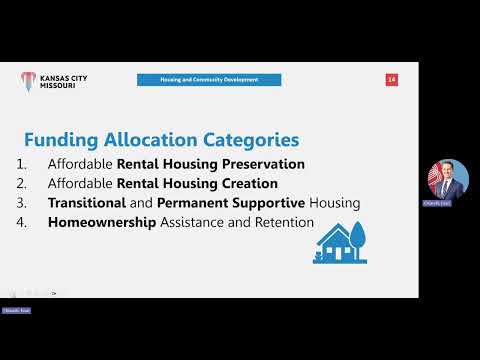
Applicants should review the Round 6 RFP guidance document posted on the Housing Trust Fund web page for detailed eligibility rules, scorecards and required materials, Shirelli said. He noted two scorecards: one for preservation/creation and transitional/supportive housing categories and a separate scorecard for homebuyer support and homeownership retention. No single category dominates scoring; evaluators will prioritize financial feasibility, demonstrated leverage of other funding, and development team experience. The guidance also outlines "qualitative considerations" that may yield bonus points, such as voucher acceptance, partnerships with the housing authority, use of land bank lots, or development in areas with displacement risk.
Shirelli described typical award limits set in municipal code: nonprofit developers may receive loans up to 30% of total development costs or grants up to 15%; for‑profit developers may receive loans up to 15% or grants up to 10%. Awarded projects must maintain at least 20% of units as affordable for a minimum of 30 years, with affordability defined as households at 60% of area median family income (he gave a 60% AMI example of just over $66,000 annually for a family of four). Minor home repair awards carry a shorter, three‑year affordability requirement.
After the May 15 deadline, staff will perform quality control, scoring and evaluation; the Housing Trust Fund advisory board will make funding recommendations at its June meeting and those recommendations will be authorized by City Council in July. Shirelli said awardees are expected to execute written agreements and begin projects within 12 months of the council’s ordinance date or face oversight actions that could include reprogramming or rescinding awards.
Materials from the workshop (including a Submittable how‑to video) are available on the Housing Trust Fund website and via Dropbox for in‑person attendees. For questions or to schedule technical assistance, staff directed applicants to housingtrustfund@kcmo.org.