Get Full Government Meeting Transcripts, Videos, & Alerts Forever!
Get email alerts on the Building Codes topic
No spam. Unsubscribe anytime.
Food truck group asks Building Code Council for phased rollout of new gas-system inspections
Summary
The Washington State Food Truck Association petitioned the BFRW committee of the State Building Code Council on May 22 to delay or phase implementation of a new requirement that professional service providers annually inspect mobile food vehicle fuel-gas systems, saying only nine providers responded to outreach for about 2,000 vendors; committee members debated emergency rulemaking, local modifications and interim compliance options such as a soap test.
Laurie Johnson, director of the Washington State Food Truck Association, told the BFRW committee of the State Building Code Council on May 22 that the association is seeking a phased implementation or temporary relief for a new inspection requirement that appears on a revised Washington State Association of Fire Marshals inspection form.
"We are just requesting, not necessarily a stop of this requirement but a phased in period of implementation," Johnson said, adding that the association contacted 89 potential service providers and found only nine willing to perform inspections — an insufficient number to serve roughly 2,000 currently health-permitted mobile food vendors before event season.
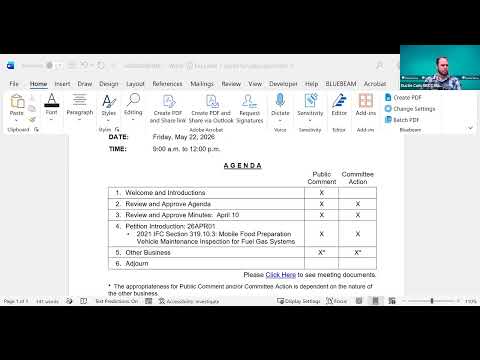
The petition asks the council to consider an emergency finding and proposed code language that would allow local jurisdictions to grant an exception or provide a temporary compliance pathway while the state and market adapt. Staff summarized the supporting materials filed with the petition, including the petition form, an emergency statement, proposed code text and the Fire Marshals Association checklist that incorporated the inspection requirement in February 2026.
Dustin (staff member), who reviewed the packet for the committee, told members that the council has 60 days to respond to a valid petition. He said the council will introduce the petition at the next full council meeting and expected that a BFRW follow-up and a council decision would occur in June; staff asked for any revisions to proposed language to be submitted promptly so documents can be posted ahead of the council meeting.
Committee members probed two issues: whether there truly are too few qualified inspectors to meet demand, and whether a statewide emergency rule is the appropriate remedy. Dan Young, a member of the State Fire Marshals Association board, said some inspection providers commonly perform the required pressure or drop tests on RVs and similar vehicles and that a phone outreach found several willing providers in multiple regions. "They do this test every day," Young said, describing manometer or drop tests and soap testing as standard practice in RV service shops.
By contrast, Ken Burlette, City of Seattle fire marshal, urged caution about a statewide exception. "I don't see this as an emergency," Burlette said, noting that the model fire code already authorizes local fire code officials to grant modifications when applying parts of the code proves impractical and that a statewide waiver could create confusion where some jurisdictions continue to enforce the section.
Several members suggested compromise approaches: clarify the emergency statement (for example, explicitly noting the February 2026 checklist change); add a sunset date on any temporary exception; provide an alternate compliance pathway (a documented soap test witnessed by a local fire official or a recorded video) while a vetted statewide provider list is assembled; or revise the checklist wording so it does not unintentionally expand enforcement beyond the model-code text.
The committee did not take formal action on the petition. It approved the meeting agenda and the April 10 minutes earlier in the session by voice vote (motion to approve the agenda was moved by Tom Handy and seconded by Dan Young). Dustin told members staff will bring revised documents, potential opinion language and checklist edits to the next BFRW meeting on June 17; staff also noted the council's response to the petition is due June 28 and that the petition will be introduced at the upcoming full council meeting prior to any formal council decision.
Next steps: the BFRW will consider revised emergency language, a possible opinion clarifying local modification authority, and edits to the checklist at its June 17 meeting; the full State Building Code Council will be asked to introduce the petition at its next meeting, and council staff aim to have a response filed by the June 28 deadline.