Get Full Government Meeting Transcripts, Videos, & Alerts Forever!
Get email alerts on the Affordable Housing topic
No spam. Unsubscribe anytime.
Soledad advisory group reviews Miramonte phasing plan, urges limits on concentrated senior affordable units
Summary
The Miramonte Affordable Housing Advisory Subcommittee reviewed a 10‑phase phasing plan that would provide 479 inclusionary units (20% requirement). Committee members urged staff and the developer to avoid concentrating low/very‑low units in senior housing, clarify duet (for‑sale) placement and deed‑restriction language, and add guarantees that required units will be built.
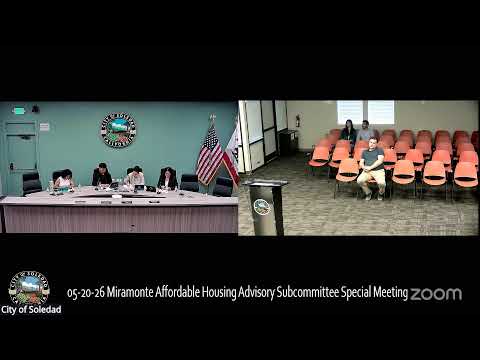
The Miramonte Affordable Housing Advisory Subcommittee on May 20 reviewed a 10‑phase phasing plan for the Miramonte development and pressed staff and the developer for clearer commitments about how the city's 20% inclusionary requirement will be delivered.
Beatrice Rubio, the city's community economic development director, told the committee the project is subject to the Inclusionary Housing Ordinance and that the ordinance requires 20% of units to be affordable: 6% very low income, 6% low income and 8% moderate income. "The total that will be required for this project is 479 affordable housing units in the 10 phased approach," Rubio said.
The plan presented by project consultants envisions building significant affordable capacity in the earliest phases. "The senior housing actually builds ahead on the affordable," said Armenta Jensen, a principal with the project planners, describing how phases 1–4 would produce about 196 affordable units (roughly 25% of units in those early phases), keeping the cumulative inclusionary share above 20% as development proceeds.
Why it matters: committee members said the early concentration of low and very‑low units inside senior housing helps the city meet its RHNA targets sooner, but raised concerns about equity and household mix. One member said reliance on senior units could shortchange families and single‑adult households who also need low‑cost homes.
Committee members asked who defines the "market" that determines building types and timing. Staff replied that developers and home builders generally set product types based on recent sales and rental demand and financing feasibility. Jensen explained that some affordable builders require a critical minimum number of units to make a project financeable, and the plan includes a crediting mechanism so units built earlier can count toward later phase requirements without reducing the overall inclusionary total.
On homeownership and duet units, staff and consultants said duets (for‑sale units shown on the plan) would need to be deed‑restricted to count toward the inclusionary ownership total and that specific unit locations are finalized in the final map process. "The only way you can guarantee going forward would be for them to be deed restricted," Jensen said. Staff suggested including maps for the first four phases as reference in the affordable housing agreement while allowing some flexibility at final mapping.
Public comment focused on policy consistency and guarantees. Christy Markey, speaking for LandWatch, said packet materials lacked sufficient detail about where affordable units would sit relative to parks and services and warned that general plan policies call for a larger affordable‑by‑design share than the IHO alone. She urged contractual protections: "There can be bonds posted to guarantee construction of inclusionary units," Markey said, recommending language in the development or affordable housing agreement to ensure required units are completed.
What the committee asked staff to do: members asked staff to explore flexibility on the senior‑unit mix (the 60/74 unit splits discussed), provide clearer spacing guidance for duets so the affordable units are integrated rather than concentrated, and to build deed‑restriction and concurrency/integration language into the affordable housing agreement. Staff and consultants noted that some changes could trigger environmental or traffic mitigation requirements tied to the specific plan and may require additional study or amendments.
The committee did not take formal action or vote at the meeting. Staff said they will return with refined language and additional materials for the affordable housing agreement and development agreement and proceed to council with revisions for review.