Get Full Government Meeting Transcripts, Videos, & Alerts Forever!
Get email alerts on the Regulation topic
No spam. Unsubscribe anytime.
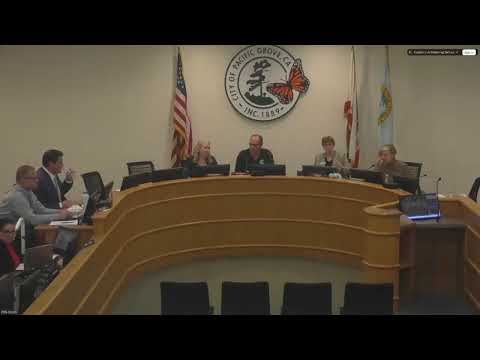
Pacific Grove council faces public outcry over cannabis 'stacking' and votes to proceed with lottery
Summary
Public commenters and applicants disputed the fairness of Pacific Grove’s cannabis licensing process, alleging multiple applications are linked to a single entity. Legal counsel advised the city that its existing ordinance does not prohibit affiliated applicants; after debate the council voted to resume the previously planned lottery process rather than cancel and restart the program.
A contentious public meeting segment on Pacific Grove’s cannabis licensing process drew large turnout and sharp public criticism alleging that multiple lottery applications were tied to a single operator, a practice critics called “stacking.”
Staff provided an ownership-and-control analysis of the 10 applications. Multiple speakers argued the applicant pool lacked transparency and that a small number of economic enterprises appeared to be entering multiple applications, giving them an unfair advantage in the city’s exclusive-license lottery. "When you look at the application packets, there's 3 economic enterprises applying for this single exclusive permit ... we were also a applicant back in 2020," said applicant/cofounder Nico Ania, who urged the city to adopt a single-owner definition to prevent stacking.
Legal counsel Erica Vega advised council that under the city’s existing ordinance there is no procedural rule that forbids related or affiliated applicants from submitting multiple entries and that the city has two defensible paths: proceed with the lottery under the current rules (legally defensible because procedures were followed) or cancel the process, rewrite the ordinance to disallow affiliated applications, and restart the selection—an option that would delay licensing and require refunding or otherwise handling application fees.
After extended public comment and discussion, the council voted to resume the lottery process and move forward with the next steps, a motion that carried on recorded roll call (motion recorded as carried). Supporters of resuming argued that the city must adhere to its adopted procedures and that the post-lottery use-permit process provides additional checks; critics said proceeding would perpetuate an unfair process and called for ordinance changes before selection.
Council directed staff to proceed with the next steps needed to carry out the lottery and emphasized continuing review of the ownership information and permitting process. The decision was framed by council members as a choice between legal defensibility and restarting the process to match public expectations of fairness.