Get Full Government Meeting Transcripts, Videos, & Alerts Forever!
Get email alerts on the Comprehensive Plan topic
No spam. Unsubscribe anytime.
Washougal presents two land-use alternatives for Onward Washougal 2045; staff seeks public comment
Summary
City staff outlined two zoning-and-growth scenarios for Washougal's comprehensive-plan update that differ in where housing and jobs are prioritized and in estimated capacity and affordability; officials opened a public comment period through March 12.
City staff presented two land-use alternatives Tuesday as part of the —Onward Washougal 2045— comprehensive-plan update, laying out projected population, housing and job growth through 2045 and asking residents to weigh in before the comment period closes.
Staff said Washougal is projected to grow by about 7,000 residents by 2045, creating demand for roughly 3,700 new housing units and between 2,100 and 2,520 new jobs. The presentation framed the alternatives as responses to those growth assumptions and as steps to align the city's regulations and capital facilities plans with the Washington State Growth Management Act (GMA).
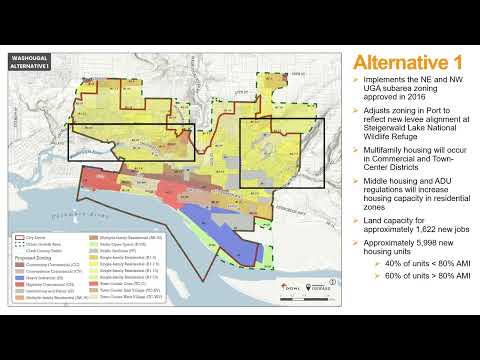
The first alternative focuses on using Northeast and Northwest urban growth areas and subarea zoning while largely maintaining the city's existing in-city zoning. According to staff, that scenario assumes expanded capacity through state middle-housing and accessory dwelling unit (ADU) allowances and would accommodate about 5,998 new housing units, with the presentation stating that 40% of those units would be designated for households earning below 80% of area median income (AMI). Staff said Alternative 1 would support an estimated 1,622 new jobs and includes an industrial zoning adjustment near the Southeast Port area to place industrial lands west of a proposed levee alignment near the Stegewald Lake National Wildlife Refuge.
Alternative 2 shifts more residential capacity to the Northeast, including use of AR (apartment residential) zoned land to support medium- and high-density housing, while allowing the town center and commercial districts to emphasize employment growth. Staff presented a different mix of land uses under this approach (town center 40% residential/60% employment; commercial districts 25% residential/75% employment), and estimated it could accommodate about 6,484 new housing units with 34% at under 80% AMI and roughly 2,007 new jobs.
Staff emphasized that both alternatives factor in recent state rules on ADUs and middle housing that allow increased units per lot, as well as development-pattern assumptions, and that the numeric capacity estimates are derived from those land-use assumptions. The presenter asked for public feedback via email, an online comment form or a paper comment card at city hall and said the city will accept comments through Wednesday, March 12; staff will review submissions and may adjust the alternatives based on the input.
At the close of the presentation the presenter said, "Your input is important as we advance these 2 land use alternatives through this planning process."