Get Full Government Meeting Transcripts, Videos, & Alerts Forever!
Get email alerts on the Property Taxation topic
No spam. Unsubscribe anytime.
Agency official explains how Gage County property valuations affect local taxes
Summary
An agency official outlined how homes and agricultural land are valued, how levies are calculated, a 30-day window to protest assessments, and the county’s timetable for finishing a full revaluation of Beatrice and the rural south.
An agency official provided a step‑by‑step explanation of how property valuations are set and how those valuations affect local tax levies in Gage County.
The official said the primary factors for valuing homes are age, condition, square footage and recent sales within the same geographic market, and emphasized that comparables should come from similar neighborhoods rather than from a village or a much larger city. "You have 30 days to file a protest," the speaker said, advising taxpayers to gather comparable sales and condition evidence before filing.
The video also described how agricultural land is classified and valued — for example, whether land is irrigated, dry or grassland and the soil class and percent composition — and said ag land is generally assessed at about 75% of value within an allowed range of 69%–75%. The presenter said Gage County’s assessment ratio is "right at about 71%."
Using examples, the official showed how dollars‑per‑square‑foot comparisons can change an assessed value. In one example, two 1920‑built homes with comparable size and condition had per‑square‑foot values of $79 and $86; a third similar house valued at $284,000 (about $114 per square foot) could be protested using the lower per‑square‑foot comparator to justify a reduced assessment in the presenter’s example.
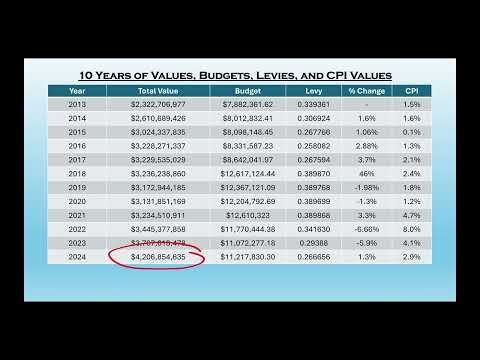
The explainer reviewed how levies are calculated: the presenter used the county’s 2024 figures — total valuation of about $4.2 billion and a budget near $11.2 million — to show the arithmetic that produces an approximate 27¢ levy (calculated on every $100 of valuation). Modeling a 2025 valuation rise to about $4.5 billion (a 7.28% increase), the official showed that if the budget remained unchanged the levy would fall to roughly 25¢, illustrating that uniform valuation increases do not automatically raise individual tax bills if elected taxing authorities adjust levies.
The video placed the math in context with a 10‑year chart of values, budgets and levies and cited the consumer price index and past "Beatrice 6" payments as reasons for past spikes in percent change. The presenter also listed the local taxing authorities that set levies — including schools (which the presenter said typically make up about 60% of a property tax bill), county government, municipalities, ESUs, NRDs, fire districts, townships and special‑purpose districts.
For taxpayers seeking more detail, the speaker pointed to the county’s online property lookup (referred to as the county’s G Works site) for a full breakdown by parcel and repeated that many valuation questions can be resolved by contacting the assessor’s office to review supporting paperwork (for example, whether a basement is finished). The presenter outlined the county’s revaluation schedule, saying the review of towns, villages and the rural north is complete and that the county plans to finish Beatrice and the rural south in the next year.
The official also cautioned that glitches are likely during a countywide rollout and urged patience: "If you see something that is really wrong and you can show that it should not be that way, they're willing to have that conversation," the speaker said. The video closed by underscoring the stated goal: equalization so "no one pays more or less than their fair share — no more, no less."