Get Full Government Meeting Transcripts, Videos, & Alerts Forever!
Get email alerts on the Markup Roundup topic
No spam. Unsubscribe anytime.
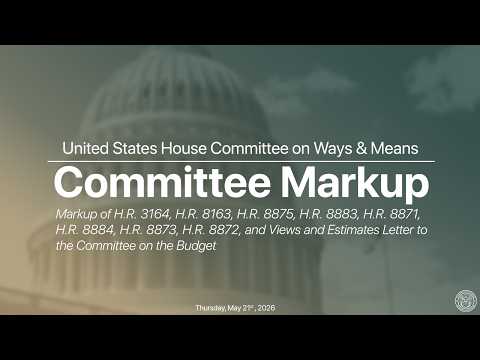
Ways and Means advances eight-bill package on health access and anti‑fraud measures, reporting several to the House
Summary
The House Ways and Means Committee on May 20 advanced a package of health-access and program-integrity bills, including measures to reimburse pharmacists under Medicare, stabilize physician payments, expand home dialysis support, and strengthen hospice and DME fraud protections; several bills were favorably reported after recorded roll calls.
The House Ways and Means Committee, led by Chairman Smith, on May 20 held a full markup and favorably reported multiple bills aimed at expanding health care access and strengthening program integrity.
The committee advanced eight bills in a daylong session. Chair Smith said the package aimed to expand access to care — especially for rural and underserved communities — and to reduce waste, fraud and abuse across programs in the committee’s jurisdiction. Lawmakers debated clinical safeguards, payment rates and anti‑fraud protections before voting to move the measures to the full House.
Key outcomes at a glance: HR 3164 (Main Street Pharmacy Access Act), which would allow Medicare reimbursement for certain pharmacist testing and evaluation services consistent with state scope‑of‑practice law, was considered as amended and ordered favorably reported to the House. Committee staff provided a technical walkthrough of the amendment in the nature of a substitute; members debated whether the payment change would create fraud risks and whether scope‑of‑practice matters should remain with states. An amendment by Rep. Judy Chu to bar pharmacies that refuse to dispense FDA‑approved birth control from participating in the reimbursement program failed in committee.
HR 8163, the Provider Reimbursement Stability Act, was adopted by the panel and reported to the House after unanimous recorded support; the clerk reported 44 yes, 0 no on the final motion to report. Sponsors said the bill modernizes the Medicare physician fee schedule and aims to stabilize payments for independent physicians.
The committee also reported HR 8875 (Improving Home Dialysis Act), which provides Medicare coverage for staff‑assisted home dialysis and renal mental‑health services, after members debated payment levels for social‑work and respite services. The committee recorded 28 yes and 13 no on the motion to report.
HR 8883 (Protecting Seniors and Stopping Fraudsters Act), focused on hospice and home‑health program integrity and increased oversight of new and high‑risk providers, was advanced after lengthy debate over whether the bill did enough to change payment incentives that can enable fraud; the motion to report passed by recorded vote, 27 yes to 16 no.
For durable medical equipment, HR 8871 (DME Scammer Prevention Act) — requiring electronic and expedited claims submissions for items identified as high risk and directing a GAO review of contractors’ fraud‑prevention technology — was reported by recorded vote (25 yes, 19 no).
On employment and Social Security, HR 8884 reauthorized limited demonstration authority for the Social Security Administration to test return‑to‑work models under SSDI with added guardrails about participant income; the committee reported the bill (27 yes, 16 no).
Separately, the committee reported HR 8873 (Recover COVID Unemployment Fraud in Banks Act), creating a federal task force to coordinate recovery of pandemic unemployment payments held by financial institutions or moved to unclaimed property and extending related statutes of limitation; the clerk reported 41 yes, 0 no.
TANF integrity and reporting proved the day’s most contentious set of debates. Republicans pushed a package (HR 8872) to apply payment‑integrity reporting to TANF, set a 200% of poverty eligibility threshold for many non‑cash uses, and establish obligational deadlines; Democrats warned provisions could be used to trigger politically motivated freezes (they repeatedly referenced a recent HHS action to withhold funds from several states). The measure was reported by recorded vote, 23 yes to 19 no.
What happens next: Each favorably reported bill moves to the House calendar where leaders will determine scheduling for floor consideration. Committee staff were authorized to make technical and conforming changes to reported measures, and members were given two days to file supplemental or minority views where allowed.
Why it matters: The bills would change coverage and payment rules affecting millions of Medicare beneficiaries (pharmacy testing/management, physician payments, dialysis support), create statutory tools to pursue pandemic-era fraud recoveries, and expand oversight authorities for hospice and DME programs. Committee debate highlighted the tension between making it easier for trusted local providers to serve patients and ensuring new payment channels don’t open fresh avenues for fraud. Republican and Democratic members also used the markup as a forum to air broader grievances about executive actions and enforcement choices affecting program integrity.
Votes at a glance (committee action reported to House): - HR 3164, Main Street Pharmacy Access Act — amendment in the nature of a substitute agreed; bill favorably reported (voice motion; amendment by Rep. Judy Chu to bar pharmacies that refuse to dispense birth control was not adopted; roll calls on the amendment recorded yeses/noes when requested). - HR 8163, Provider Reimbursement Stability Act — amendment in the nature of a substitute agreed; favorably reported (roll call reported: 44 yes, 0 no). - HR 8875, Improving Home Dialysis Act — amendment in the nature of a substitute agreed; favorably reported (roll call reported: 28 yes, 13 no). - HR 8883, Protecting Seniors and Stopping Fraudsters Act (hospice/home health integrity) — amendment in the nature of a substitute agreed; favorably reported (roll call reported: 27 yes, 16 no). - HR 8871, DME Scammer Prevention Act — amendment in the nature of a substitute agreed; favorably reported (roll call reported: 25 yes, 19 no). - HR 8884, Removing Barriers to Work for Disabled Americans (SSDI demonstration authority) — amendment in the nature of a substitute agreed; favorably reported (roll call reported: 27 yes, 16 no). - HR 8873, Recover COVID Unemployment Fraud in Banks Act — amendment in the nature of a substitute agreed; favorably reported (roll call reported: 41 yes, 0 no). - HR 8872, Preventing Waste, Fraud, and Abuse in TANF Act — amendment in the nature of a substitute agreed; favorably reported (roll call reported: 23 yes, 19 no).
Who said what: Quotes in this article come from the committee record and are attributed to members who spoke during the markup. Representative Adrian Smith described HR 3164 as a narrow, reimbursement‑only change that ‘‘does not touch scope of practice’’ and defers to state law. Representative Beth Van Dyne said HR 8883 ‘‘is about protecting vulnerable patients’’ and strengthening oversight of hospices. Representative Lloyd Doggett asked repeatedly whether several bills meaningfully addressed the ‘‘multimillion‑dollar elephant in the room’’ (fraud) and pressed sponsors on whether the bills would generate measurable savings. Representative Neal (ranking member) said Republicans’ emphasis on fraud must not become a cover for political targeting of particular states or programs.
What reporters should watch for next: which bills House leadership schedules for floor consideration; any floor amendments that change payment or fraud provisions; CBO scoring and committee exchanges with CMS on implementation authority; whether HHS uses expanded reporting to take administrative steps (particularly relevant to ongoing disputes about TANF enforcement and prior agency freezes).
Ending note: The markup produced bipartisan votes on some items (notably the provider stability and pandemic‑fraud recovery measures) and partisan splits on others (hospice and TANF integrity). Members on both sides signaled continued oversight plans and follow‑up work as the bills move toward possible House floor action.