Get Full Government Meeting Transcripts, Videos, & Alerts Forever!
Get email alerts on the Land Use topic
No spam. Unsubscribe anytime.
City officials defend eminent domain move for Villa Rica Parkway as residents warn of displacement
Summary
At a packed town hall in Villa Rica, city staff and elected officials described the route, financing and legal steps behind a council decision to pursue eminent domain for nine parcels; long-time residents and civil-rights advocates said the project threatens a historic Black neighborhood and demanded transparency.
City officials and staff laid out the technical and financial reasons behind a controversial decision to pursue eminent domain for parcels tied to the Villa Rica Parkway at a town hall meeting at the Bishop Holt Center.
City Engineer Mark Teal described the route selection and property impacts, saying the half‑mile parkway alignment was chosen after considering longer and more environmentally costly alternatives. Teal said the city has acquired roughly 90% of needed frontage—about 2,374 linear feet—and that roughly 264 linear feet remain. Of the project’s total footprint, he said there have been 16 total acquisitions so far; nine houses were impacted in total, and two of those were owner‑occupied.
Jennifer Holman, the city’s deputy city manager and meeting moderator, explained project financing. The city issued $19 million in bond proceeds through a tax allocation district (TAD) to fund both Fortune (now Robbie Bishop) Parkway and Villa Rica Parkway, she said. Fortune Parkway cost about $3.6 million; Villa Rica Parkway is estimated at about $15.4 million and is being built in two phases. Holman said about $3.5 million had been spent through April on engineering, design, appraisal and acquisition, roughly $3.0 million of which was acquisition expense.
Teal also flagged a time‑sensitive permit condition with the U.S. Army Corps of Engineers: the city must install a bottomless culvert by March 14, 2027 or risk losing permits or incurring stream‑credit penalties, a constraint he said affects scheduling.
Nicole Smith, the city attorney, described the eminent domain process in plain terms: the city obtains an independent appraisal, offers compensation and—if an owner does not agree—files a condemnation action and deposits funds equal to the appraisal with the court. "Property owners do get paid," she said, and owners retain legal remedies and may continue negotiating after a filing.
Councilwoman Conte, who said she is a Black resident of Villa Rica, acknowledged deep public anger and mistrust and explained that during an executive session on May 12 the council was presented with two difficult options: refuse to move forward and risk substantial litigation and financial exposure, or proceed under existing contractual obligations and negotiate to achieve the best outcome for affected owners. Conte said those legal and financial realities informed her vote and that the council’s decision was not taken lightly.
Many residents challenged that account during a lengthy public‑comment period. Vicky Dobbs, who identified herself as speaking for family members in the affected neighborhood, said the vote feels "like a betrayal to the people, history, and legacy that helped shape the community." Joyce Knowles, who said her family has lived on the property for decades, and other long‑time homeowners said they will fight any attempt to take homes.
Speakers pressed the city on several factual points reported in the community, and staff addressed common misinformation: Holman said only one of the nine remaining parcels contains an occupied residence slated for acquisition at this phase; the TAD mechanism does not change the tax rate on properties and funnels new development tax revenue to repay bond debt; and a $1.7 million grant referenced in public discussion was rescinded because the city applied before it could meet grant timelines, not because of fraud, and no grant funds were expended.
Residents also asked for environmental and title information. Teal pointed out two primary creek crossings on the alignment near Gordon and Cleghorn streets, and he said cultural‑resource and permitting work with the Corps were completed for those crossings. Several speakers asked the city to make environmental impact studies, appraisals and title searches more accessible; staff said those records can be provided and invited written follow‑up.
Questions at the town hall also reflected broader concerns about development strategy and whether the parkway primarily benefits new subdivisions such as Mirror Lake. The city’s explanation emphasized connectivity, pedestrian access and emergency access improvements as part of a longer, multi‑decade effort to better connect parts of Villa Rica and support downtown revitalization.
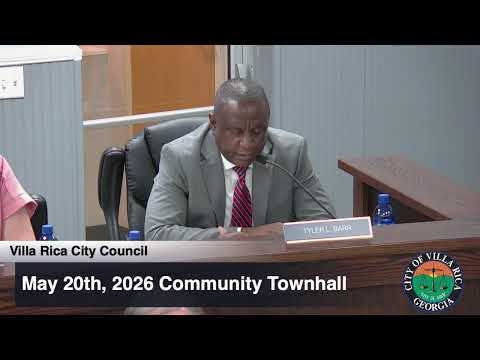
Moderator Holman invited residents to email outstanding questions for formal follow‑up. Councilman Tyler Barr, who said he voted after reviewing staff and legal advice and the obligations the city had already incurred, closed the meeting by acknowledging the depth of public anger and urging residents to meet with council members and staff so officials can address outstanding facts and concerns.
Next steps: staff said they will share requested documents and that residents may continue to negotiate with the city even after an eminent domain filing. No final construction schedule or additional council actions were announced at the meeting.