Get Full Government Meeting Transcripts, Videos, & Alerts Forever!
Get email alerts on the Land Use Data Centers topic
No spam. Unsubscribe anytime.
Bradley County adopts stricter zoning for data centers after packed public hearing
Summary
After hours of public comment and dozens of speakers urging protections, the Bradley County Commission amended its zoning code to restrict cryptocurrency mining and data centers to a higher-impact industrial district and impose 3,000-foot buffers from homes, schools and FAR zones; the substitute motion passed unanimously.
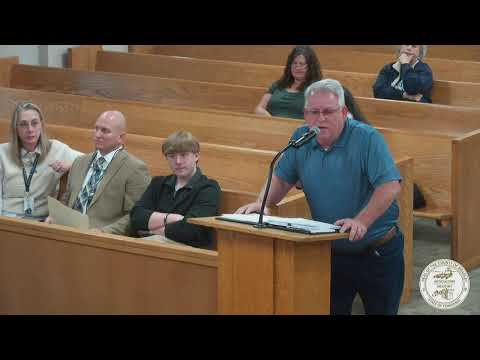
A crowd of residents packed the Bradley County Commission chamber on April 20, 2026 to oppose large-scale data centers and cryptocurrency mining operations near homes and schools. After a public hearing that ran for hours, the commission approved a substitute amendment to the county zoning resolution that allows crypto-mining and data centers only in the I-2 (special impact industrial) district and prohibits them within 3,000 feet of any FAR (forestry/agriculture/residential), R-1 or R-2 zones, existing residence, school or church.
Commissioner Chris Rogers, who introduced the original draft, said a "yes vote today is a vote to be proactive" and framed the measure as putting "standards, regulations, and restrictions in place on data centers, AI data centers, and crypto mining operations before one ever shows up at our doorstep." Bentley Thomas, Bradley County's planner, told the commission he had developed a model template with the Tennessee County Planners Association covering location limits, sound requirements and assurances from utility providers.
Speakers representing a wide cross-section of the community urged stronger protections. Chris Stone, a resident of North Mouse Creek Road, said, "This is personal to me" and described proximity of the proposed site to Walker Valley schools and his family property. Caitlin Spack asked commissioners to add limits on acreage and water and energy use, warning that "the only thing these data centers bring are reckless irreversible environmental damage" if left unchecked. Several farmers and livestock owners raised concerns about noise, "infrasound" and impacts on animals and crops; others called for a moratorium or an outright ban.
Commissioner Louie Alford offered a substitute motion to restrict these uses to I-2 and to add a 3,000-foot exclusion around FAR, residential districts, schools, churches and existing dwellings; he put the amendment in the form of a substitute motion and a second was obtained. During subsequent discussion, planners and the county attorney clarified that rezoning to I-2 would still be required for specific sites (only the county landfill was zoned I-2 at the time), and that the resolution would take effect on adoption.
The commission approved the substitute motion on a roll-call vote, 14–0. County officials said the change will immediately become part of the zoning resolution and that any future site-specific proposals in other zones would require rezoning and the associated public process. Several commissioners acknowledged the draft could be further tightened through future amendments but said the adopted language was intended to create immediate guardrails where none existed.
The decision came after multiple speakers asked for enforceable conditions such as noise limits measured at property lines, hydrological impact studies, decommissioning plans for abandoned sites, limits on backup generators and independent monitoring of water and air impacts. Commissioners said those kinds of permit-level and conditional-use standards remain available tools either by tightening the resolution or through subsequent rezoning and permit conditions.
The county clerk recorded the unanimous vote; Chairman announced the resolution would become effective upon adoption. The planning commission's prior work (a January 15 recommendation and further review) informed the draft the commission acted on. The county encouraged residents to continue engaging at future planning and commission meetings and reminded the public that meeting video is available on the county website.
What happens next: Any developer wishing to pursue a site not already zoned I-2 must seek rezoning and comply with any new conditions the county attaches, including possible special-impact review. Commissioners noted state law limits certain local fiscal tools (such as broad impact fees) and county staff said legal counsel will review additional authority for enforcement and monitoring as proposals arise.