Get Full Government Meeting Transcripts, Videos, & Alerts Forever!
Get email alerts on the Housing Development topic
No spam. Unsubscribe anytime.
Developer introduces five‑story Emerson Street proposal; residents and council raise preservation and displacement concerns
Summary
On May 11, 2026, PM Properties introduced a plan to replace two buildings at 1103–1105 Emerson with a five‑story, 30‑unit rental building that the developers say will include 10% inclusionary units at 40% AMI; nearby residents and council members urged preservation review because the site abuts Ebenezer AME Church and historic Black block landmarks. The committee introduced the ordinance for further review; no final vote was taken.
Evanston — PM Properties representatives introduced a proposal May 11 to replace two aging structures at 1103–1105 Emerson Street with a five‑story, 30‑unit residential building intended to add family‑oriented housing to a neighborhood near downtown.
Walter Matan, who said he and his sister Nata Papovic own PM Properties, told the Planning & Development Committee the project would offer a mix of one‑, two‑ and three‑bedroom units, include about 10% “IHO” (inclusionary housing ordinance) units and that those units would be set at roughly 40% of area median income. Matan said the owners are not seeking property‑tax relief and are aiming to meet the city’s stated sustainability goals while keeping the development in long‑term family ownership.
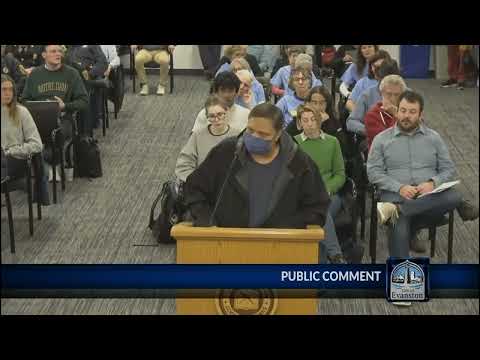
The proposal drew strong public comment from residents and members of the committee who said the block has outsized historical significance to Evanston’s Black community. “This is a historical Black block,” Tina Peyton told the committee, saying her family has lived on Emerson for 111 years and urging referral to the Preservation Commission. “It’s called removal of the Black community,” Peyton said, arguing the scale of the project and its proximity to Ebenezer AME Church risked displacement.
Council member Kelly said the design still needs work to integrate with the block’s character, expressed parking and congestion concerns and urged that the Preservation Commission be allowed to review the project given the church’s landmarked status. “Given its proximity to this landmarked church, I think that’s the least we could do,” Kelly said.
Council member Rogers framed the project as the kind of mid‑sized, family‑friendly housing the city should encourage, noting a shortage of two‑ and three‑bedroom units downtown. The developers and council members described ongoing outreach: meetings with Ebenezer AME Church, a draft good‑neighbor agreement and an offer to provide a pre‑construction condition survey and an engineer to document the church’s condition before work begins.
Developers read into the record a list of proposed mitigation measures under negotiation with the church: a photographic pre‑construction condition survey, a storm‑water drainage plan to prevent runoff onto the church property, a 24‑hour emergency contact, construction insurance documentation for church review, and commitments on amplified‑sound controls and optional noise monitors to track decibel levels.
The committee also discussed how city inclusionary‑housing rules apply. The chair said the city recently strengthened its inclusionary housing ordinance (raising baseline percentages) while allowing applicants to provide fewer units if those units are deeper‑affordability tiers. Matan said the applicants would forgo pursuing Cook County tax abatement in order to provide more deeply affordable units at 40% AMI rather than the 60% AMI tier tied to the county program.
No formal action was taken on the ordinance itself at the Planning & Development Committee meeting; members moved to introduce item P2 so the proposal can proceed through the review process and return for later action. Council and developers said they expect to include the drafted good‑neighbor agreement and any Preservation Commission feedback in the council packet before the item is considered for final action.
The project will next appear on the City Council agenda for continued review and potential action, with Preservation Commission comment and the developers’ good‑neighbor agreement expected to be part of the materials provided to council.