Get email alerts on the Waste Management topic
No spam. Unsubscribe anytime.
Inside Roanoke County’s curb-to-landfill process
Summary
A Roanoke County field report follows curbside trash to the Tinker Creek Transfer Station and Smith Gap landfill; county staff describe transfer, loading and engineered landfill layers and say the system can move up to 3 million pounds a day on peak days.
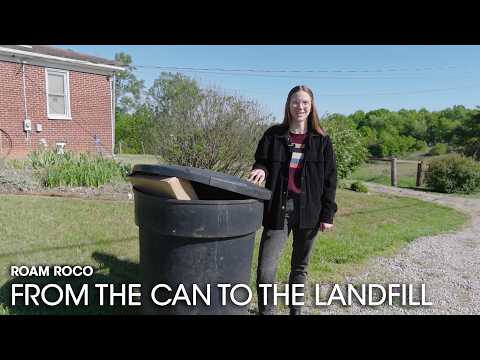
Reporter: A Roanoke County field crew followed curbside trash from the can to the landfill to show how local transfer stations and the Smith Gap landfill handle and contain municipal waste.
Tiffany, introduced on camera as director of community engagement, said the Tinker Creek Transfer Station is "the hub of where everything starts to happen." She described curbside trucks dumping on a tipping floor where crews use bulldozers and an excavator to load tractor-trailers that carry compacted waste to the landfill. "We make sure it's the right weight because it's going to go on its next journey," Tiffany said.
Tiffany told the reporter the county operates multiple transfer facilities and serves other localities and contractors; she said throughput "can fluctuate" but that the system "can move up to 3 million pounds of trash a day." The segment notes residents and contractors also use the transfer stations.
At the Smith Gap landfill, Joey explained the site's history and daily operations. "Since 1993," Joey said when asked how long the landfill has been open. He estimated that on a heavy day roughly 50 to 60 tractor-trailers arrive, with daily variation based on total tonnage.
Joey described the engineered structure of the landfill: alternating layers of dirt, an HTP layer, stone layers and a leachate collection system that together are designed to prevent discharge and erosion. He said crews place waste in roughly 10-foot lifts, compact the material and maintain a working face "at a proper height," citing EPA and DEQ regulations the site follows. "We pride ourselves on keeping a nice landfill," Joey said, adding that staff and visitors often comment on the site's upkeep.
The field report also included a short ride-along with a collection driver, who said his route takes "at least 700 to 800" cans a day and that it took months to learn to drive the right-side-drive truck used on his route. He named Bent Mountain as a favorite route outside winter weather.
Tiffany closed by inviting residents to learn more online and by touring the facilities: "They can find us at rv.net. We're also on Facebook, Instagram, and LinkedIn. And we also offer tours."
The report focused on operations and engineering practice rather than policy decisions; no votes or formal actions were recorded. The most recent procedural detail in the segment is the invitation for public tours and posted online information about the facilities.
AI generated
The text on this page is AI generated. Summaries, highlights, analysis, and video transcripts are all produced from the original source material.
AI can make mistakes, so if you spot one, and we will fix it for everyone.
Note: the source content is unaltered by us. Any content source we link to, be it a video, an audio recording, or a document, is presented exactly as its publisher released it. That publisher is usually a government body, sometimes an individual official or another organisation.