Get Full Government Meeting Transcripts, Videos, & Alerts Forever!
Get email alerts on the Un Briefing topic
No spam. Unsubscribe anytime.
U.N. spokesman flags attacks near nuclear site, humanitarian shortfalls and Ebola emergency in wide-ranging briefing
Summary
A U.N. press briefing summarized the Secretary-General's meetings in Japan and warned of threats to civilian infrastructure after reported drone strikes near the Barakah nuclear plant, highlighted deep humanitarian funding shortfalls for Gaza and Sudan, and noted WHO's declaration of an Ebola public health emergency in the DRC; the briefing included a multi-topic Q&A on navigation in the Strait of Hormuz, UNRWA premises and other concerns.
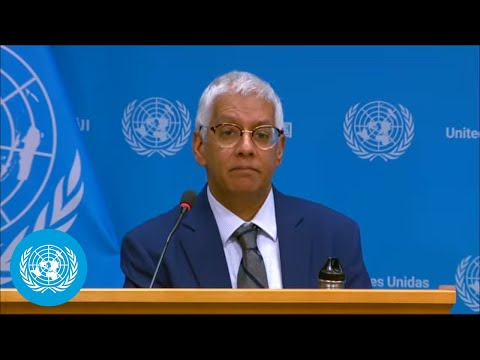
The United Nations’ spokesperson Farhan briefed reporters on a string of international crises, saying the organization is closely monitoring a reported drone strike that struck an electrical generator within the perimeter of the Barakah Nuclear Power Plant in Abu Dhabi and warning that "attacks on nuclear installations are totally unacceptable, a violation of international law, and must be condemned."
Farhan said the International Atomic Energy Agency is following the incident closely and is in constant contact with UAE authorities, ready to provide assistance if needed. He urged all sides to avoid further attacks near civilian infrastructure and to halt fighting that risks civilian lives and critical facilities.
The briefing also stressed worsening humanitarian conditions across multiple theaters. The Office for the Coordination of Humanitarian Affairs (OCHA) told the U.N. that the 2026 flash appeal for the occupied Palestinian territory — seeking just over $4 billion to support nearly 3 million people — is currently only 12% funded with $490 million received so far. "In Gaza, the U.N. and our humanitarian partners are supporting kitchens and serving 1 million meals a day," Farhan said, noting that figure is down from 1.8 million daily meals in February. He added that "one in five families is eating only once a day" and that constraints on fuel, spare parts and movement are undermining operations.
On public health, Farhan said the World Health Organization declared the Ebola outbreak in the Democratic Republic of the Congo and Uganda a public health emergency of international concern because the outbreak involves the Bundibugyo strain, for which there are currently no licensed vaccines or specific therapeutics. He gave the latest operational figures the U.N. has: more than 482 suspected cases in Ituri since April, including eight confirmed cases and around 116 deaths among suspected cases. The U.N. and partners have supported the response, including the World Food Programme airlifting more than 5 tons of WHO medical supplies, but the DRC humanitarian plan of $1.4 billion is only about one-third funded, the spokesperson said.
Farhan also reviewed security developments affecting U.N. personnel and missions. He recounted UNIFIL reports of sustained kinetic activity in Lebanon, detailed firing-incident tallies attributed to positions identified as originating from Israeli Defence Forces and Lebanese non-state actors, and said a UNIFIL position near Al-Bayada sustained "significant damage"; he emphasized that U.N. premises and personnel must be protected. The spokesperson reported an incident near the Al-Naqoura seaport in which IDF soldiers halted a UNIFIL convoy and inspected an ambulance.
Reporters pressed the spokesperson on several country-specific issues during a Q&A. Asked whether restrictions on navigation through the Strait of Hormuz could amount to crimes against humanity, Farhan said the Secretary-General called the situation "dire" and emphasized restoring "basic freedom of navigation as enshrined in the law of the sea." In response to queries about Iran's newly announced Persian Gulf Strait Authority, he said the U.N. does not want any entity to restrict freedom of access on the high seas. On press reports that Israeli forces may have established covert bases in western Iraq, Farhan said he expects the Security Council to take up such matters.
When asked about Israeli operations in Gaza that reportedly killed civilians, Farhan said, "we are opposed to attacks that kill civilians," adding that Israel must "use extreme caution and avoid any attacks that have a disproportionate civilian effect." Regarding UNRWA premises in East Jerusalem, Farhan said U.N. sites are inviolable under the 1946 Convention on the Privileges and Immunities of the United Nations and that the legal office is considering next steps.
Why it matters: the briefing linked acute security incidents with deep, underfunded humanitarian responses and an emergent public-health threat, underscoring multiple near-term risks to civilian protection and delivery of life-saving aid. The U.N. is calling for greater donor support, stronger protections for U.N. premises and personnel, and restraint by parties engaged in hostilities.
The press briefing closed with the U.N. noting upcoming meetings — including the CEB sessions and DESA briefings — and with reporters raising additional questions on Cuba, Bangladesh and other matters. The spokesperson reiterated that extradition and bilateral accountability processes remain the responsibility of member states and that the U.N. will continue to press for cooperation and accountability where appropriate.