Get Full Government Meeting Transcripts, Videos, & Alerts Forever!
Get email alerts on the Workforce Pell Implementation topic
No spam. Unsubscribe anytime.
States to decide which short-term programs qualify for Workforce Pell as federal rules near completion
Summary
A Midwestern Higher Education Compact webinar explained how Workforce Pell expands Pell eligibility to short-term, accredited programs; federal rules are expected in late May with a statutory effective date of July 1, 2026, and states — chiefly governors — will certify eligible programs.
Carrie Wanler, senior director of policy initiatives at the Midwestern Higher Education Compact, opened a webinar that reviewed the new Workforce Pell expansion and its implications for institutions and states.
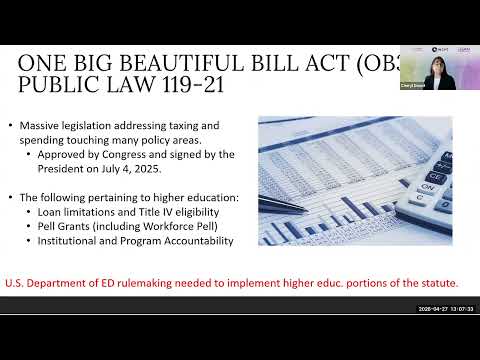
Cheryl Dow, senior director for WCT Policy Innovations and the State Authorization Network at the Western Interstate Commission for Higher Education, said the Workforce Pell expansion is grounded in federal statute enacted in the 2025 omnibus (referred to in the session as "OB3") and is intended to extend Pell Grant eligibility to short‑term programs that align with state workforce priorities. "This is not a new financial aid program," Dow said. "It merely expands the availability of Pell to short‑term programs." She emphasized that the program draws from existing Pell funds, which could affect fund availability across applicants.
Why it matters: The statute sets a tight implementation timeline and places primary responsibility for program approval with states. Dow said the Department of Education had received roughly 440 public comments on the Workforce Pell proposed regulation and that a related negotiated‑rulemaking committee had drawn tens of thousands of comments. She added that the department had constraints from the statute but expected final regulations to be released in late May and become effective by the statutory deadline of July 1, 2026.
Key eligibility and accountability rules: Dow outlined the statutory requirements institutions and programs must meet to qualify for Workforce Pell: programs must be for undergraduates, be need‑based and nonrepayable, last at least 150 clock hours but fewer than 15 weeks (150–599 clock hours), be offered by an accredited, Title IV‑eligible institution, be state‑approved, and lead to a stackable, portable industry credential. Dow said distance education is an allowable modality.
Not all programs qualify. Dow said correspondence courses, programs under 150 clock hours, remedial courses, and programs not aligned with state‑verified, in‑demand occupations are disqualified. Eligible programs must have been operating for at least one year before applying for Workforce Pell eligibility.
Accountability measures are central to the rule. Dow described outcome thresholds included in the proposed regulation: at least 70% completion within 150% of the program length; at least 70% job placement of program completers in the field for which they were trained within 180 days (with an initial on‑ramp period); and a median earnings benchmark tied to 150% of the federal poverty level so that median completer earnings exceed total tuition and fees.
State role and interstate delivery: Dow repeatedly stressed that Workforce Pell is state‑led: governors or designated state entities will certify programs that meet state standards before the Department of Education performs federal review. She said state variability is a feature, not a flaw, and that states will use local labor‑market data to determine which occupations and programs count as high‑need or high‑wage. For interstate distance education, proposed rules allowed bilateral agreements between states for program approval, and Dow noted that programs that lead to professional licensure could require additional approval from licensing boards.
Guidance for institutions: Dow urged colleges and training providers not to rush into applications. "Build internal awareness," she said, and set up cross‑functional teams to assess program fit, mission alignment, risks and opportunities. Institutions should monitor the final rule, engage with state policymakers, and review existing certificates that could be eligible rather than immediately creating new programs.
Unanswered questions from Q&A: In the webinar Q&A, participants asked whether institutional accreditation type matters, how Workforce Pell interacts with the Pell lifetime cap, and whether the 70% employment metric could discourage continued education or stacking. Dow reiterated that institutional accreditation is required and that if programmatic accreditation or licensure applies, institutions should account for that; she also confirmed Workforce Pell counts against a student’s Pell lifetime limits. On the employment metric, Dow acknowledged concerns and said commenters raised the disconnect between stackability and an immediate employment benchmark; she said those issues were the sort likely to be addressed through public comments and in forthcoming final guidance.
Next steps: The hosts reminded participants that the slide deck and a recording would be posted and promoted a follow‑up session focused on implementation strategies scheduled for May 14, which will include state officials from Pennsylvania, New York, Ohio and Missouri. "This is less about immediate action and more about intentional positioning," Dow said.
The webinar did not include formal votes or decisions; it provided regulatory and practical guidance for states and institutions preparing for Workforce Pell implementation.