Get Full Government Meeting Transcripts, Videos, & Alerts Forever!
Get email alerts on the Road Safety topic
No spam. Unsubscribe anytime.
Gardner City staff present preliminary high‑injury network, propose speed cushions and quick‑build demos
Summary
Project staff presented a preliminary high‑injury network based on 2021–2025 crash data, reported about 120 online public comments and a 10‑person April meeting, and proposed demonstration projects — including temporary speed cushions and rapid‑flash beacons — to test safety countermeasures before permanent work.
Gardner City project staff and consultants updated the Vision Zero Advisory Committee on the preliminary high‑injury network (HIN) and early outreach for the city’s safety action plan, saying the work will guide short‑ and long‑term countermeasures.
"We're just about really ready to start identifying countermeasures that will form really the safety action plan," said Bill, a project presenter, summarizing the team’s progress and outreach since the last meeting. Staff said the April 29 public meeting at the police department drew about 10 attendees and that the project’s interactive mapping tool has captured more than 120 comments.
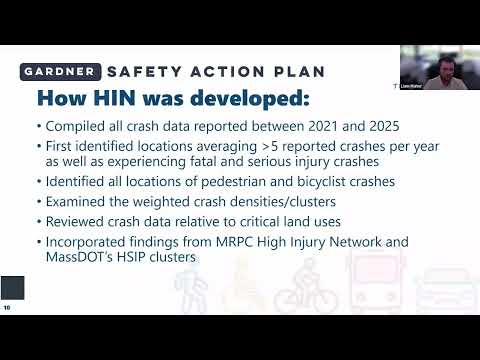
The HIN was developed using crash reports from a statewide portal for 2021–2025, weighted by severity and cross‑checked against the MRPC regional plan and MassDOT crash clusters, Liam, the project analyst, told the committee. Staff said the HIN focuses on roadway segments and intersections with high counts of fatal or serious‑injury crashes and clusters of pedestrian and bicyclist collisions.
Staff identified multiple city corridors and intersections for further work. Highlights from their counts and field observations include:
• Tony Boulevard (downtown to the Rotary and southward): about 333 crashes in the study window, including eight crashes involving vulnerable users; reported contributing factors included failures to yield, improper lane keeping and careless driving. • West Broadway (Route 2A): 65 crashes, including three fatal crashes and four involving vulnerable users; staff noted sidewalk gaps, visibility problems near driveways and speeding. • Main Street (Parker to Chestnut): 215 crashes, two serious injury crashes and 13 crashes involving vulnerable users; staff pointed to frequent failure to yield and speeding despite some curb extensions and bumpouts. • Pleasant Street: 39 crashes, including one serious injury and five involving vulnerable users; staff cited mixed land uses, occasional parking‑related visibility problems and signal compliance issues.
At specific intersections, staff noted safety‑related signal and geometry issues. For example, the Tony Boulevard/West Broadway signal was reported to lack a protected pedestrian phase except on the south leg and had short pedestrian timing (15–20 seconds), raising exposure for people crossing. Parker/Oak/West showed several rear‑end collisions near crosswalks, suggesting problems with following distance and merge geometry.
To address these problems the team proposed a menu of countermeasures across three pillars: engineering (e.g., rapid‑flash beacons, corner tightening, medians, buffered bike lanes), enforcement (targeted speed enforcement supported by state public‑safety grant funding) and education/promotion. Bill cited Federal Highway research showing certain countermeasures — for example, rapid‑flash beacons at crosswalks — can substantially reduce pedestrian crossing crashes, and said an individual beacon installation can be on the order of tens of thousands of dollars compared with multimillion‑dollar intersection reconstructions.
The team plans demonstration (quick‑build) projects — temporary installations using markings, cones, delineators or planters — deployed for one to two months with before/after data collection to test effectiveness before recommending permanent changes. "If we go ahead and do it, we collect data beforehand, have them out there for a month or two, collect data while it's out there to determine the effectiveness and then use that information to make a decision," Bill said.
Committee members asked about how the city’s HIN compared with the regional list and whether regional Road Safety Audits (RSAs) would move Gardner locations forward. Staff said most regional problem areas remain relevant locally but that no RSAs in the regional package were recommended specifically for Gardner. Members discussed demonstration priorities; one member endorsed temporary speed cushions as a feasible, low‑cost trial that could win council and mayoral support if results are positive.
Staff said next steps include coordination with FHWA and the traffic commission (staff contact Rob), selection of demonstration locations tied to the HIN, a second public meeting this fall, a proposed third VSAC meeting on July 15 at 10 a.m., and a final report by year‑end. Staff also said they will follow up to determine whether state grant reporting requirements will require police reporting back to the committee.
The committee did not take formal votes during the meeting; staff will post the HIN map and a legible table on the project website and circulate materials to members for follow‑up.