Get Full Government Meeting Transcripts, Videos, & Alerts Forever!
Get email alerts on the Traffic Calming topic
No spam. Unsubscribe anytime.
Fairfax County staff present John Milton Drive speed‑hump plan; task force moves to mailed ballot
Summary
Fairfax County Department of Transportation staff presented a plan proposing two speed humps on John Milton Drive, reported traffic counts and speed data that qualified the street for calming, and said the neighborhood task force voted to move the plan to a mailed ballot (208 ballots; voting June 1–30). Residents raised concerns about a prior failed ballot, device height, and crosswalks.
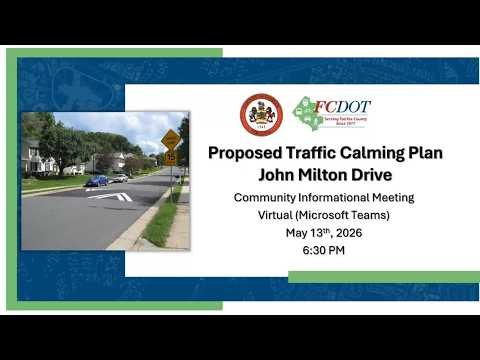
Steve Knutson, a project manager with the Fairfax County Department of Transportation (FCDOT), opened a community meeting on the proposed traffic‑calming plan for John Milton Drive and introduced FCDOT staff Ryan O'Carroll and Grace Boone and Shamali from Hunter Mill District Supervisor Alcorn's office.
Ryan O'Carroll outlined the county's five‑step traffic‑calming process and said the proposal for John Milton resulted from community initiation and subsequent study. He reported a 24‑hour recorded volume of 2,532 vehicles and said 85th‑percentile speeds were 36 mph eastbound and 34 mph westbound; the eastbound direction met the county's speed threshold for traffic calming. O'Carroll described required device siting limits and showed a draft field map proposing two 12‑ft‑long speed humps 3 inches high at center with 15 mph advisory signage.
The presentation covered the ballot phase procedures: every occupied property in the ballot area receives one ballot, the ballot period is open a minimum of three weeks, and the district supervisor's office tallies results. Staff said the ballot area includes 208 eligible ballots and that the plan requires 105 yes votes to pass and move to Board of Supervisors endorsement and VDOT acceptance. If successful, staff estimated endorsement and scheduling would take roughly 4½ to 7 months before installation.
Residents asked questions during the Q&A. Janet Healey confirmed the counts shown were the most recent (March) and consistent with earlier studies. Several residents, led by a caller identified as Alyssa, objected to returning to a ballot only a year after a prior unsuccessful ballot and cited a county two‑year waiting guideline for reentry; Alyssa said the neighborhood had voted in 2025 and questioned why the county was pursuing a new ballot so soon. "I disagree with the county ignoring its own 2‑year waiting period," she said, and noted prior 85th‑percentile figures she read from earlier studies that she argued barely met the threshold.
FCDOT staff responded that they had recollected fresher data, that the new counts were similar to earlier measurements, and that staff had decided to offer a second ballot because the previous mailing included anomalies (a partially cut‑off map) that raised concerns about the integrity of the first process. On device construction, staff said installed humps in nearby Pinecrest comply with the county's 3‑inch specification and that measurements are checked in the field.
Residents raised several local concerns: safety for pedestrians near the shopping plaza and school, the visibility and grade around the Quincy Adams/Oliver Cromwell intersection, whether the ballot could be split to vote on each hump separately (staff said it cannot), and whether the county or homeowners would pay for installation (staff said the county will cover installation from its budget). Staff also said requests for additional crosswalks or signs must be considered through the county and VDOT active‑transportation review; staff noted a request to VDOT is already in process for some locations.
Task force member Janice said the task force had agreed to move forward to ballot and that she would receive ballots and paperwork from FCDOT; she said ballots will be mailed at the end of May and the voting window will run June 1–30, with pre‑addressed return envelopes directed to Supervisor Alcorn's office. Staff posted FCDOT and Hunter Mill contact information for follow‑up questions.
What happens next: the task force will confirm distribution, ballots will be mailed, and the district supervisor's office will tally returns. If the plan receives at least 105 yes votes, FCDOT will seek Board of Supervisors endorsement and then submit the endorsed resolution to VDOT; installation would be scheduled after those approvals.
The meeting closed with staff thanking participants and offering contact email dotinfo@fairfaxcounty.gov and the Hunter Mill office (huntermillbos@fairfaxcounty.gov) and listing a phone contact for project questions.