Get Full Government Meeting Transcripts, Videos, & Alerts Forever!
Get email alerts on the Downtown Economic Development topic
No spam. Unsubscribe anytime.
Downtown Mesa Association outlines services and $982,000 budget as council prepares to consider assessment
Summary
At a May 18 study session, Downtown Mesa Association leaders reviewed cleanup, parking and event operations, reported key metrics (29 tons of trash removed; Mesa Amplified drew an estimated 27,000 attendees) and detailed a proposed $982,000 budget that the council will consider under agenda item 12A.
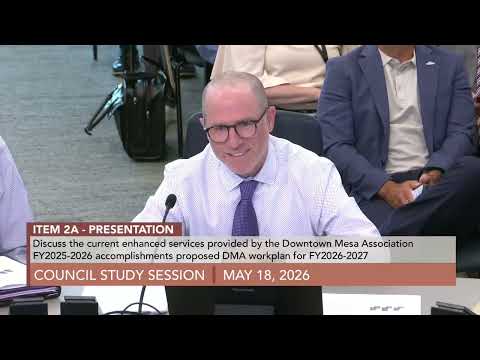
Downtown Mesa Association leaders presented an annual work plan, operations metrics and a proposed budget during a Mesa City Council study session on May 18.
Jimmy Trakas, executive director and president of the Downtown Mesa Association, told the council DMA’s priorities are downtown appearance and safety, parking management, communications, activation and business engagement. “Trash removal is the biggest piece of that with 29 tons of trash removed,” Trakas said, summarizing the clean team’s work. He said DMA operates a six-person clean team that responds to litter, illegal dumping and graffiti and maintains public spaces such as Mesa City Plaza and the Neon Garden.
The presentation outlined parking management and enforcement figures: DMA said it administers more than 2,000 permits, issued about 2,600 tickets this year and provided nearly 2,000 warnings. Trakas described the permit revenues as a pass-through: “it is directly revenue that comes back to the city,” he said, noting DMA keeps a small administrative fee before forwarding funds and that the Office of Management and Budget uses the revenue to offset DMA’s professional services contract.
City and DMA staff summarized DMA’s funding structure and contract role. Jeff McVay, manager of urban transformation, said the DMA program is funded from three buckets: property tax assessments of roughly $350,000, a city voluntary self-assessment of about $230,000 and an enhanced services contract of about $400,000. In total, staff said DMA’s budget would be about $982,000. Staff also said DMA maintains special-event parking revenue and has allocated up to $50,000 from that account toward additional parking enforcement staffing.
Trakas highlighted downtown programming and marketing efforts that aim to increase foot traffic, including the new Meet Me in Mesa video campaign and a renewed social strategy. He pointed to large events as revenue drivers: DMA estimated Mesa Amplified brought more than 27,000 people to Main Street and said the Barbecue Classic drew roughly 20,000 people over two days. Trakas credited local businesses—naming The Nile, The Salt Mine and Cider Core—for helping produce Mesa Amplified.
Council members asked questions about student parking, wayfinding and partnerships. Trakas said ASU students account for many repeat overstays and described prior efforts to designate student permits; council members discussed a possible pilot circulator shuttle to connect underused garages with ASU and major downtown destinations. On wayfinding, staff said signage updates tied to the micro-mobility plan are underway and that DMA could partner with the city to implement more visible directional signage.
Trakas also described DMA programs that support merchants: a downtown-only gift card program with about 40 participating businesses, five merchant promotions per year, quarterly merchant meetings and more frequent in-person visits to address business concerns.
Council members raised notices of protest. Trakas said DMA received two protest letters about the proposed assessment; he said one author submitted three letters and that two of his parcels are residential and therefore not assessed. City staff characterized the protests as coming from out-of-state property owners who do not see direct benefit from the assessment, and noted that roughly 550 parcels are assessed, which staff said makes the small number of protests notable.
No formal council action was taken at the study session. City staff said the DMA item (item 12A) will appear on the council meeting agenda for formal consideration. The council then acknowledged board minutes and moved on to other agenda items.