Get email alerts on the Public Safety Rfa topic
No spam. Unsubscribe anytime.
North Bend authorizes exploratory talks with Fire District 38 about forming regional fire authority
Summary
Council voted 5‑1 to authorize the mayor to initiate discussions with Fire District 38 about creating a regional fire authority (RFA), a multi‑step process that would form a planning committee, draft an RFA plan, and, if approved, ask voters to ratify formation and any funding mechanisms.
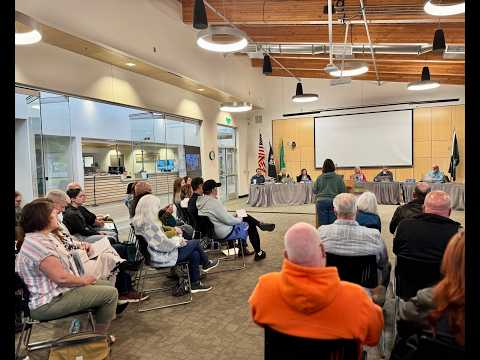
North Bend City Council authorized May 19 the mayor to begin discussions with Fire District 38 about forming a regional fire authority (RFA), a governance body that would plan and, if ratified by voters, assume responsibility for fire and emergency medical services across participating jurisdictions.
Staff framed the RFA option as a three‑step statutory process: (1) a planning committee (six members, three appointed by each governing body) prepares an RFA plan that addresses governance, service deployment, financing and asset disposition; (2) the plan is submitted to the respective bodies for review and any modifications; and (3) a ballot measure is presented to voters of each member jurisdiction for approval. Finance staff emphasized the potential fiscal effects: shifting contract costs for East Side Fire and Rescue into an RFA could change the city's levy capacity and the mechanism used to fund fire service (taxes versus a fire benefit charge).
Fire District 38 Chair Chris Pauline spoke to the council, outlining historical partnerships between the city and the district, potential economies of scale and the possibility of spreading costs across a larger membership while preserving service. Pauline said the fire benefit charge is optional and that governance details (including board structure and voting) would be resolved by the planning committee and included in the draft plan.
Council debate noted both benefits (long‑term fiscal sustainability, regional coordination) and outstanding questions: how representation and voting would be structured in the RFA, how asset transfers would be handled, whether voters would be asked to approve a fire benefit charge or a tax rate change, and how any city general‑fund adjustments would be considered if fire service funding shifts out of the general fund.
Council authorized the mayor to enter preliminary discussions and to proceed with formation steps; the motion passed 5‑1 (Councilmember Rob McFarland opposed, citing concerns about unknowns and potential governance and service impacts). Staff said, if council approves, appointments to the planning committee could be scheduled at the next meeting so work can proceed on a tight timeline to inform possible voter action in a future election.
Vote: AB26‑049 exploration authorized (5‑1).
AI generated
The text on this page is AI generated. Summaries, highlights, analysis, and video transcripts are all produced from the original source material.
AI can make mistakes, so if you spot one, and we will fix it for everyone.
Note: the source content is unaltered by us. Any content source we link to, be it a video, an audio recording, or a document, is presented exactly as its publisher released it. That publisher is usually a government body, sometimes an individual official or another organisation.