Get Full Government Meeting Transcripts, Videos, & Alerts Forever!
Get email alerts on the Alpr topic
No spam. Unsubscribe anytime.
Chandler council hears presentation on merging Flock license‑plate reader contracts as privacy questions persist
Summary
At a city study session, Chandler officials heard police and vendor presentations on merging two Flock Safety license‑plate reader contracts into a single renewal covering 40 cameras; councilmembers pressed staff on data ownership, retention (30 days), interagency sharing and audit controls and requested more details before a Thursday vote.
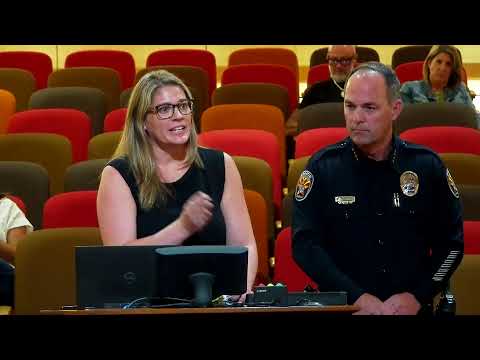
Chandler City Council members spent the bulk of a study session hearing a presentation on consolidating two existing contracts with Flock Safety and renewing the city’s automated license‑plate reader (ALPR) program, and pressed police and vendor representatives for details about data ownership, retention and interagency access.
Police staff and a Flock Safety representative said the city currently operates 40 ALPR cameras — an initial 14 approved in March 2023 plus 26 added in May 2025 — sited on major thoroughfares and commercial corridors rather than in residential neighborhoods. "The city of Chandler owns 100% of their data," Katie Daffan A, a public‑affairs representative for Flock Safety, told the council. She added that Flock does not sell the data and described the vendor’s security posture, including SOC 2 compliance and penetration testing.
Councilmembers asked repeatedly who can query Chandler data, under what conditions, and how long images and alerts are retained. Staff said sharing with other local or state agencies is opt‑in and managed through agency agreements; they described a tiered access model where routine searches against the national database are available but deeper access to city records is granted case‑by‑case. Councilmember Orlando asked how another agency (for example, Tempe or the U.S. Marshals) would obtain information; staff said Chandler would choose what to release and that many queries are tied to active investigations.
Retention and audit policies drew sustained attention. Police staff told the council that Chandler retains ALPR records for 30 days and that data older than 30 days is purged automatically. The department also described 30‑day internal audits and an automated flagging system that alerts administrators to anomalous query patterns. Katie Daffan A said vendor staff do not have ordinary access to Chandler’s plates and that vendors maintain a small set of security‑cleared employees who may assist law‑enforcement partners on technical issues.
Public‑trust concerns underpinned much of the questioning. "I think it's a public trust issue," Councilmember Harris said, citing community worries that federal partners could use task‑force access to pursue immigration enforcement. The police chief replied that the Marshals Task Force is "guided to look for violent offenders" and that, to his knowledge, the Marshals have not requested ALPR data for immigration enforcement; he added that any federal request would be handled with the city manager and city attorney on a case‑by‑case basis.
Councilmembers also sought numbers showing the program’s operational results. Staff said fiscal‑year‑to‑date there have been "over 7,600" alerts and offered two recent examples presented to illustrate impacts: locating a missing elderly driver with early‑onset dementia and apprehending an out‑of‑state suspect wanted for crimes against children. Staff said they track recoveries (stolen vehicles, plate recoveries, missing persons) and offered to provide more detailed case and resolution counts ahead of the Thursday vote.
Several councilmembers asked whether the contract contains protections in the event of a security breach. Staff said the reviewed contract includes termination rights, indemnification, insurance and remedies to recover damages if vendor obligations are not met. Flock representatives said they have conducted penetration testing and worked with independent security teams and law‑enforcement cyber units to rebut social‑media claims of past hacks.
The council did not vote; members directed staff to supply additional technical, legal and audit documentation before the full council meeting on Thursday when the merged contract and renewal will be considered.