Get Full Government Meeting Transcripts, Videos, & Alerts Forever!
Get email alerts on the Oversight Transition topic
No spam. Unsubscribe anytime.
Oakland Police Commission finalizes CMC statement, urges collaborative transition to local civilian oversight
Summary
At a May 18 ad hoc meeting the Oakland Police Commission read and finalized a near‑final case‑management conference statement, agreeing to submit it the next morning and urging a collaborative transition with OPD, the OIG and CPR to sustain compliance after exit from court oversight.
The Oakland Police Commission’s NSA ad hoc committee on May 18 finalized a near‑final case‑management conference (CMC) statement and agreed to submit it to the city attorney’s office the following morning by 9:00 a.m., the committee chair said.
The statement, read aloud during the meeting, calls for a collaborative transition structure between the commission, the Oakland Police Department (OPD) and city leadership to complete three outstanding NSA sustainability tasks and to build the commission’s capacity to serve as a primary civilian oversight body after the department exits court monitorship. "The commission's proposal for the best‑suited transition structure ... is to work collaboratively with the Oakland Police Department and the City of Oakland leadership towards compliance," the chair said while reading the draft.
Why it matters: the CMC filing is intended to show the court and parties a plan both to finish remaining reform tasks and to ensure sustained compliance through local civilian oversight. The statement highlights cultural change at OPD as essential and lists three priorities to achieve it: productive relationships with city and community stakeholders (including an independent OIG), transferring certain Internal Affairs Bureau (IAB) investigations to the Community Police Review agency (CPR), and the city’s long‑term fiscal support for the commission’s independent oversight role.
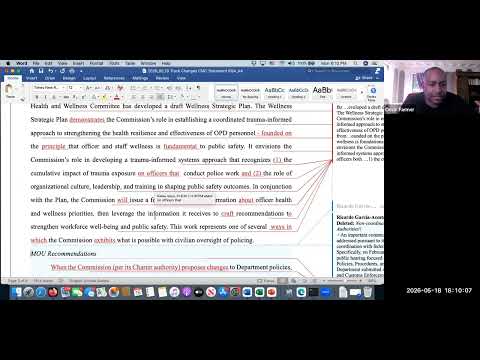
The statement also reports progress on selecting a new permanent police chief: the commission hosted six community forums, collected nearly 200 resident surveys and completed interviews with applicants, and will forward a shortlist of candidates to the mayor, the chair said. The document details other policy work including a draft officer wellness strategic plan the commission’s mental health committee developed "founded on the principle that officer and staff wellness is fundamental to public safety." The chair said the commission will issue a formal request for information to refine recommendations on workforce well‑being.
The draft further notes CPR’s increased staffing plans under a larger budget — from seven toward 15–17 permanent employees — and timelines to hire investigators in the June–July timeframe and additional managers into 2026 to meet NSA deadlines. It describes CPR’s mediation program (codified in Open City Ordinance 13498 in 2018) as a restorative‑justice pathway for residents with complaints against sworn officers.
IG offered a suggested edit during the meeting to add a brief bullet listing completed OIG work so the filing reflects both achieved activities and planned projects. "We just need cooperation. We need a timeline," IG said, requesting clearer timelines and documented coordination with OPD for audits and reportouts. Meeting participants agreed IG would draft a short completed‑work bullet and send it to the document editor for inclusion before the filing deadline.
The ad hoc did not take any formal vote at the session; members instead agreed to submit the revised statement and to continue refining related materials — the OPD template and a time‑sensitive proposal letter — at upcoming meetings.
The committee scheduled follow‑up work for the OPD reporting template and for the proposal letter, and targeted the commission’s next meeting on June 11 for additional discussion and potential finalization.