Get Full Government Meeting Transcripts, Videos, & Alerts Forever!
Get email alerts on the Air Quality Session Overview topic
No spam. Unsubscribe anytime.
NJDEP opens 2026 environmental‑justice air‑quality tour in Elizabeth, outlines permitting and monitoring tools
Summary
The New Jersey Department of Environmental Protection launched its 2026 environmental‑justice community engagement tour in Elizabeth, where officials described how air permitting, EJ rules and monitoring tools work and invited community input on local concerns including data centers, ports and odors.
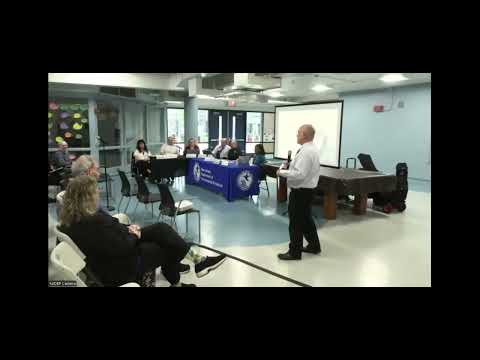
Candace Perry, director of the Office of Environmental Justice at the New Jersey Department of Environmental Protection, opened a May community session in Elizabeth to kick off the agency’s 2026 environmental‑justice engagement tour, saying the DEP wants to “meet with you, listen, and talk” about air quality and neighborhood impacts.
The session brought together acting Commissioner Ed Patasnick and DEP technical staff to explain how air permitting, environmental‑justice rules and monitoring fit together and to answer residents’ questions. Patasnick emphasized DEP’s dual role of enforcing federal and state laws while responding to local community concerns: “We have to follow the rules,” he said, but the department is working to deliver results in overburdened communities.
DEP officials front‑loaded an explanation of how permits are evaluated. Ken Ratzman, assistant director of the air quality division, said permit reviewers determine whether an application meets federal Clean Air Act requirements and the state pollution‑control law; if it meets the rules, the department generally must issue the permit. Ratzman summarized three EJ‑linked tools that affect permits: a localized impact control technology requirement for new or expanded facilities, facility‑wide risk reviews at renewals for major sources, and technical‑feasibility analyses for older equipment at renewal time.
Why it matters: residents and advocates say permitting outcomes shape local air exposures for neighborhoods near ports, highways and industrial facilities. DEP officials said the EJ rules add layers to the technical review but cannot substitute for statutory thresholds; the department repeatedly urged community participation in public hearings and early engagement on permit applications.
The DEP also described monitoring and public‑facing resources. Anthony Carl, bureau chief for the Bureau of Air Monitoring, reviewed the state’s 29 regulatory stations, the Air Quality Index, the EnviroFlash notification service and an ongoing mobile monitoring project conducted with university partners. Melissa Evanego, assistant director of the Bureau of Air Monitoring and Mobile Sources, said community sensors and loan programs help identify local concerns but are used in conjunction with regulatory monitors.
The session included an enforcement overview. Jeff Meyer, bureau chief for air enforcement in the Northern Region, explained inspections, civil enforcement tools (from warnings to administrative orders and penalties) and the procedures for investigating odor complaints; odor enforcement generally requires DEP or county investigators to verify the smell on a complainant’s property while the incident is occurring and to have the complainant sign a statement to support an enforcement action.
Community members raised multiple concerns during a long Q&A: the Williams Transco compressor‑station permit, ethylene oxide, data centers’ backup generators, truck routes and idling near Kean University, and beach and residential open‑burning. DEP staff pointed attendees to the agency’s “What’s in My Community” mapping tool, the DEP 24‑hour hotline for reports, and a survey link to collect localized transportation and idling hotspots. Officials said slides and resources would be shared after the session and the Office of Environmental Justice would follow up on specific requests via environmentaljustice@dep.nj.gov.
Taken together, DEP officials framed the session as both an explanation of technical limits and an invitation to sustained community engagement — emphasizing that federal and state rules set permit baselines, while EJ rules, monitoring and public input shape how those baselines play out in neighborhoods.