Get Full Government Meeting Transcripts, Videos, & Alerts Forever!
Get email alerts on the Planning And Housing Policy topic
No spam. Unsubscribe anytime.
Council adopts UDO technical package and directs planning on housing and electrification
Summary
Council adopted a four‑ordinance package of UDO technical and substantive amendments (Ordinances 2026-08—2026-11), and passed resolutions directing Plan Commission and HAND to prepare UDO amendments for affordability and to craft long-term affordability frameworks.
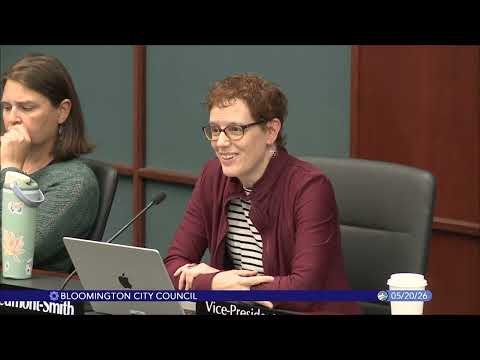
At its May 20 meeting the Bloomington Common Council adopted a set of Unified Development Ordinance (UDO) corrections and changes and advanced two council-initiated housing policy directives.
What passed: the council approved four ordinances (2026-08 through 2026-11) covering technical fixes and substantive edits to the UDO. Notable changes highlighted by Development Services staff included:
- Removal of the "determinate sidewalk variance" process in favor of a payment‑in‑lieu mechanism to the city’s alternative transportation fund; the Plan Commission will set an annual rate and the Transportation Commission will review requests. Staff said the shift is intended to convert recorded variances that rarely result in built sidewalks into a fundable alternative for pedestrian improvements.
- Revised parking-lot landscaping calculations (perimeter-oriented model) to better align plantings with realistic lot geometry and to reduce impractical shrub/plant quotas.
- Removal of early "standardized business" language that in practice proved difficult to administer; the code will instead rely on clearer signage and façade rules.
Council also adopted Resolution 202605 (sponsored by Council Member Flity) directing the Plan Commission to prepare UDO amendments on reduced minimum lot sizes/widths, sustainability incentives including building electrification in PUDs, and elimination of minimum parking requirements. The measure included a clerical correction to procedural text and passed on roll call.
Separately, the council adopted Resolution 202606 directing the Housing & Neighborhood Development (HAND) Department to prepare a framework for legally permissible long-term affordability tools (silent-second mortgages, rights of first refusal, shared-equity models) and to report back to council within roughly 120 days.
Why it matters: those directives represent a council-level push to use the UDO and municipal tools to pursue lower-cost housing forms, electrification incentives, and parking‑policy changes intended to reduce development costs and emissions. The payment-in-lieu approach for sidewalks centralizes funding decisions in the alternative transportation fund rather than leaving numerous recorded variances on property titles.
What’s next: Plan Commission will begin work on the directed UDO amendments; staff will propose a payment-in‑lieu rate for sidewalk relief for Plan Commission consideration. HAND will prepare an affordability framework and return recommendations to council in the timeline set by Resolution 202606.