Get Full Government Meeting Transcripts, Videos, & Alerts Forever!
Get email alerts on the Multifamily Development topic
No spam. Unsubscribe anytime.
Residents press council to deny 296-unit Magnolia Parkway apartment plan; town hall set on SB 840
Summary
At a May 18 joint Pearland City Council and Planning & Zoning workshop, residents opposed a proposed 296-unit apartment development on Magnolia Parkway. The developer outlined concessions and cited market demand; council agreed to hold a public town hall to discuss the project and the implications of Senate Bill 840.
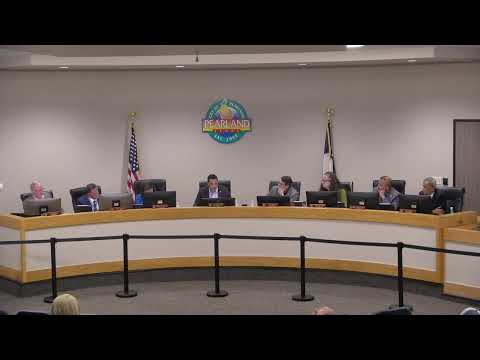
A joint workshop of the Pearland City Council and Planning and Zoning Commission on May 18 reviewed a request by Rockport Ventures LLC to rezone about 15.0375 acres on the north side of Magnolia Parkway for a three-building, 296-unit apartment complex. The meeting drew multiple speakers during public comment urging denial and prompted council members to schedule a community town hall to examine the proposal and the effects of state law Senate Bill 840.
Opponents at the podium said the site is incompatible with nearby single-family neighborhoods. "I oppose the development of another 296 units of this type in the vicinity of the intersection," said Donnie Streuhal, a Wesley subdivision resident, citing traffic, strain on utilities, and public-safety impacts. Ann Struhall, also of Wesley, told the council a "300-unit apartment complex is not a minor adjustment" and said the project would intensify traffic and put additional pressure on drainage systems that have not yet been tested by a major storm.
The developer, Travis Donnell of Rockport Ventures LLC, urged the council to reconsider and outlined a list of concessions he said were added in response to neighborhood concerns: reducing the project from earlier designs to three buildings, lowering height to three stories, eliminating third-floor balconies facing nearby homes, expanding setbacks to as much as 275–350 feet on one side and 90 feet on the north, providing a large on-site detention basin, and offering planned off-site improvements including a Hawk crosswalk near Massey Ranch Elementary School. Donnell said the existing Delta Pearland project across Magnolia reached 98% occupancy shortly after opening and argued the site has limited alternative uses, calling housing "the highest and best use" of the tract.
Staff described preliminary technical details: the applicant proposes 504 parking spaces (62 covered), a preliminary unit mix of roughly 60% one-bedroom, 35% two-bedroom and 5% three-bedroom units, and design commitments such as photometric plans intended to limit light spill and a shadow study to assess sunlight impacts. The site was annexed in 1999; the staff presentation noted prior related requests and said staff had received one written comment in support and 87 in opposition as of midafternoon the day of the workshop.
Several Planning & Zoning commissioners and council members stressed the tension between negotiating design via a plan development (PD) and the limits imposed by Senate Bill 840, which staff characterized as allowing mixed-use or multifamily residential uses in certain commercial or office zones once a city exceeds 150,000 population and thereby constraining some local zoning controls. "There is a host of regulations that set limits on that multifamily development," a planning official said while explaining the law's scope. Multiple council members said they were concerned that the statute could limit the city’s ability to secure the concessions developers are offering today.
Councilmember Patel pressed the applicant on whether the latest submission meaningfully differed from the version denied five months earlier and raised data-based concerns, including calls for more durable perimeter fencing and skepticism about long-term upkeep of garden-style apartment components. Supporters of the revised plan — including Cathy Tidalski of the Southwick Section 1 HOA board — said the applicant had addressed many neighborhood concerns and noted the developer’s offers to host town halls and to fund off-site safety improvements.
With continued public interest and the state-law question looming, the council and several commissioners agreed to direct staff to plan a community town hall focused on housing, multifamily development, and SB 840 in collaboration with state legislators. State Rep. Barry (present at the meeting) summarized the bill’s evolution in the Legislature and offered to participate in community briefings.
No final zoning decision or vote was taken at the workshop. The council moved to adjourn at 6:24 p.m. Next steps identified at the meeting include staff scheduling the town hall (the developer announced a separate developer-hosted town hall May 21 at the Pearland Recreation Center) and the developer moving forward with a formal PD application that would trigger mailed notices, a sign on the property, and newspaper publication as required by city ordinance.