Get Full Government Meeting Transcripts, Videos, & Alerts Forever!
Get email alerts on the Fire Department topic
No spam. Unsubscribe anytime.
Caldwell workshop spotlights fire department shortfalls, recommends phased new stations and dozens more firefighters
Summary
Consultants told the Cobalt City Council workshop that Caldwell’s fire service faces staffing shortfalls, limited 4‑minute coverage and rising call volumes; a phased plan centered on Station 4 and future stations, plus dozens of hires, was recommended, with funding partly from ARPA.
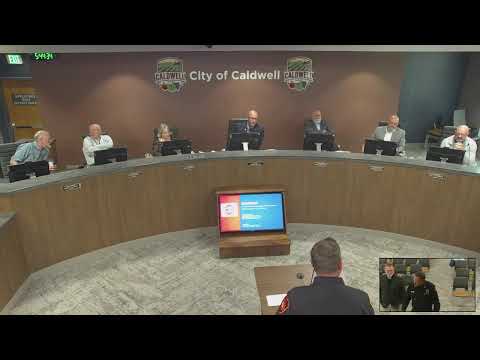
Consultants from Emergency Services Consulting International (ESCI) on Tuesday presented a yearlong study to the Cobalt City Council workshop that warned Caldwell’s fire department is already behind on staffing and coverage and recommended a phased plan of new stations and additional hires as the city grows.
Jeff Stone, a former fire chief with ESCI, summarized findings from a community risk assessment, a standards-of-cover analysis, a station-location study and a recent strategic plan. The work used a five‑year dataset (2020–2024) and was partially funded with American Rescue Plan Act (ARPA) dollars, Stone said.
The study estimated Caldwell’s service population at roughly 79,000 inside city limits plus about 5,000 in contracted rural areas, for a planning total near 84,000. Based on that population and industry benchmarks, ESCI used a planning midpoint of 1.1 firefighters per 1,000 residents to size staffing. At that level the department would need roughly 90–93 operational firefighters; the department currently has about 69 personnel, leaving a shortfall of about two dozen staffers under the midpoint model.
Why it matters: ESCI highlighted two coverage metrics that drive outcomes for structure fires — a first unit arriving within four minutes and an effective response force (the combined staffing that arrives to fight a structure fire) arriving within eight minutes. Stone said national guidance and NFPA recommendations put the effective response-force target for a residential structure fire at about 15 firefighters. "If you don't stay up with that growth, those risk numbers are going to increase," Stone said, warning that the department can meet the 15‑person effective response force only a small fraction of the time under current staffing and cross‑staffing practices.
The consultant projected rapid growth for the service area. Using a combined average growth rate of about 3.6 percent, the model estimated the service population could more than double by 2050 and exceed 200,000 in the combined area unless planning and capacity keep pace. Stone told the council Caldwell had already run about 9,200 calls so far this year and described that call volume as "10 years ahead" of earlier projections.
Station siting and near-term impacts: ESCI incorporated Caldwell’s current station network and GIS coverage in its analysis. With three city stations in service now — and Station 4 under construction and expected to open next year — Stone said Station 4 alone would increase four‑minute coverage by roughly 16 percentage points, improve call coverage by about 7–8 percent and increase structures covered by about 13 percent. The report recommended a phased approach to identifying sites and securing land for Stations 5–7 tied to development timelines for large proposed subdivisions.
Staffing, apparatus and cross‑staffing: Stone described operational limitations tied to cross‑staffing of specialty units (hazmat, marine, water tender) and said the department’s daily minimum staffing of 16 people is the bare minimum to run apparatus. He and the chief warned that cross‑staffing increases risk because reassigning personnel to one unit can leave others undermanned.
Councilor questions and budget signals: Council members pressed the consultant and the chief on costs and timetable. Councilor Stotik asked how to justify large equipment and apparatus costs when medical calls now make up the majority of responses; he said it is hard to explain "where we spent maybe 90% of our budget on 25% of our work." Stone and the chief pointed to long apparatus lifecycles, supply‑chain delays and insurance/ISO implications when trucks are not available.
Councilor Tillman noted the scale of hires implied by the report and asked how many personnel the budget would add; the chief and staff said the upcoming budget includes nine additional positions (plus three) to staff Station 4, but that the city still faces hiring dozens more personnel over the next several years to approach planning targets.
Operational adjustments: Councilor Dinsburg asked whether deploying squad trucks improves EMS coverage and reduces heavy-truck movements. The chief responded that squads are more efficient when staffed, but are frequently unavailable when personnel are shifted to cover leave or training.
Mutual aid and implementation risks: Stone emphasized mutual‑aid balance and the need to monitor one‑sided mutual‑aid burdens. He presented the study’s phased timeline for implementation and urged councilors to review the full reports and coordinate site selection, land acquisition and hiring in advance of major subdivision build‑outs.
No formal council votes were recorded during the workshop; the presentation was informational and councilors asked questions about budget timing, staffing and next steps. The council adjourned the workshop and convened the regular council meeting at 6:00 p.m.
What’s next: ESCI recommended that the city review the full community risk assessment and station‑location maps, begin identifying potential station sites for phase‑one expansion, and develop a multiyear hiring plan tied to the Station 4 opening and projected subdivision timelines. The presentation materials and full reports were provided to councilors for follow‑up.