Get Full Government Meeting Transcripts, Videos, & Alerts Forever!
Get email alerts on the Land Use Fraternity Cup topic
No spam. Unsubscribe anytime.
Council upholds revocation of fraternity conditional use permit at 280 California Boulevard
Summary
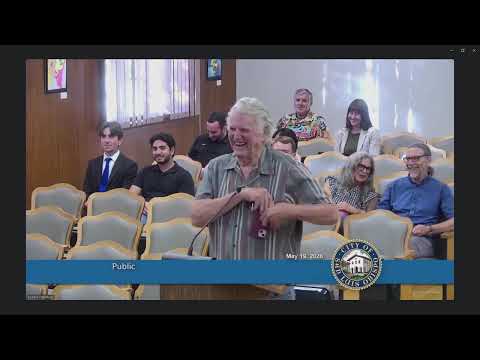
The San Luis Obispo City Council on May 19 upheld a Planning Commission decision to revoke the conditional use permit allowing Alpha Epsilon Pi to operate at 280 California Blvd, citing repeated noise and CUP violations; council denied the fraternity's appeal on a 4-0 vote.
The San Luis Obispo City Council voted May 19 to deny an appeal from the Alpha Epsilon Pi chapter at 280 California Boulevard and to uphold the Planning Commission's March 11 decision to revoke the property's conditional use permit for fraternity operations. Council members cited multiple confirmed noise citations and breaches of CUP conditions as the basis for the decision.
Staff presented the history and recommendations preceding the appeal, saying the CUP was originally approved in 1983 and modified in November 2024 to include a 25-person maximum for gatherings and a re-review trigger if the site received three citations within 12 months. The record provided by police and code enforcement included three noise citations that staff said resulted in CUP violations and warranted the Planning Commission re-review. The staff report recommended denial of the appeal and upholding the revocation.
Appellant Joshua Pinsky, who identified himself as the Sigma Omega chapter president at 280 California Boulevard, told council his chapter had made substantial operational changes and reported an 85% reduction in citations over two academic years. Pinsky urged the council to amend CUP conditions (adjust the three-citation trigger to an academic-semester standard, revise the 25-person limit, and create clearer measurable noise standards) and to favor collaborative oversight rather than revocation.
Supporters of the appeal, including Interfraternity Council president Neil Partasari, emphasized financial burdens on student organizations and urged proportionate, behavior-based enforcement. Neighbors and other residents who spoke during public comment and at the Planning Commission hearing described episodes of disruptive events at the property, some with police citations that listed roughly 100'to—150 people present. Neighbors and staff described investigations that included police incident reports and event registration records showing events that exceeded the 25-person threshold without special event permits.
Council members discussed the limitations of the CUP system and acknowledged the appellant's progress, but several said the factual record of citations and violations constrained the council's review. After deliberation, Mayor Erica A. Stewart moved to deny the appeal; Vice Mayor Francis seconded. The council voted 4-0 (Council Member Shoresman absent) to uphold the Planning Commission revocation; staff said the fraternity could reapply for a CUP at any time.
What happens next: staff told council that revocation requires fraternity operations as defined by code to cease. If activities continued in a way that staff could show they were sponsored by the fraternity (advertising, collecting money, use of Greek letters, or other evidence of sponsorship), the city could pursue land-use violation enforcement. Council and staff also noted longer-term policy work is planned: a May 26 study session on code enforcement and a suggested future work-plan item to review the city's regulatory approach to fraternities and sororities.
The decision preserves the Planning Commission's finding that recent operation of the property was incompatible with adjacent residential uses and detrimental to neighborhood health, safety and welfare. The council directed staff to consider administrative lessons from the case and flagged the need for broader collaboration with Calpali on campus meeting space, enforcement policy, and related housing policy.