Get Full Government Meeting Transcripts, Videos, & Alerts Forever!
Get email alerts on the Homelessness Pathway topic
No spam. Unsubscribe anytime.
Benton County HOPE board backs planning for workgroups to strengthen pathway from unsheltered homelessness to housing
Summary
At its January meeting, the HOPE advisory board endorsed CRO planning to form workgroups focused on creating a defined pathway from unsheltered homelessness into shelter and permanent housing and on coordinating rental-assistance funding; CRO cited a Housing 360 grant and FHSP lease-ups as foundations for the work.
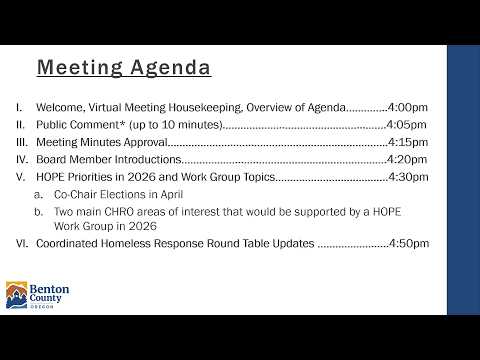
The HOPE advisory board convened by Benton County’s Coordinated Homeless Response office on Jan. 1, 2026, endorsed staff plans to form workgroups that will design operational steps to move people from unsheltered settings through shelter and into permanent housing.
CRO program manager Rebecca Taylor said the office will leverage a competitive Housing 360 state grant to design a “follow-the-person” approach that connects street outreach, rapid response and housing navigation so every step of a household’s journey has the resources and training needed. “We would focus that funding in on figuring out ways to follow a person all the way from, you know, a tent all the way to permanent housing,” Taylor said.
Why it matters: CRO leaders said the operational work cannot succeed without stable funding, and one of the workgroup charges will be to identify how to braid short-duration funding from different agencies to create uninterrupted assistance for tenants. CRO asked each HOPE member to identify one or two staff members (managers or front-line rental-assistance staff) who can contribute subject-matter expertise to planning the workgroups.
Program updates that informed the request included the Flexible Housing Subsidy Pool (FHSP) and CRO’s property-manager outreach pilot. Julie Arena of the CRO reported the FHSP had supported lease-ups and that the CRO’s coordinated outreach and leasing work had rehoused 58 households to date. Rebecca Taylor said a DST-funded property-manager outreach pilot yielded a 92% success rate for 54 lease-ups, with four households needing relocation but no evictions because staff intervened.
CRO also outlined near-term operational steps: drafting an RFI/RFQ for supported property management (to be released in early February), preparing for the PIT (point-in-time) count with volunteer recruitment and incentives, and convening focus groups and lunch meetings with private market property managers to learn best practices for lease-ups and retention.
Board reaction and next steps: Members expressed support for the approach and emphasized coordination across jurisdictions and funding streams. April Holland, Benton County public-health director, urged tight operational connections between agencies to ensure services do not drop off. CRO leaders said they will return in April with co-chair elections and more fleshed-out workgroup proposals; in the meantime, they asked members to email recommended staff contacts within about a week so planning can begin.
CRO leaders said the proposed workgroups are intended to be planning and operational—both designing system improvements and supporting immediate service delivery—so the county can scale outcomes while meeting state reporting and rehousing targets.