Get Full Government Meeting Transcripts, Videos, & Alerts Forever!
Get email alerts on the Mental Health Training topic
No spam. Unsubscribe anytime.
Mental Health Connecticut spotlights Mental Health First Aid training in Connecticut Paid Leave podcast
Summary
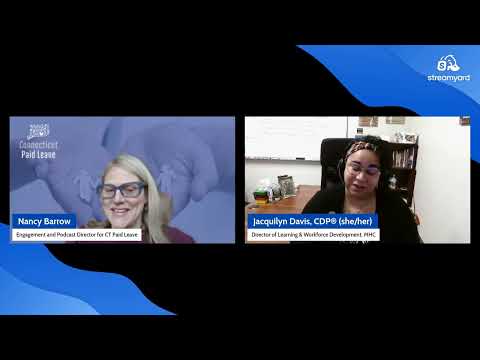
Jacqueline Davis, director of learning and workforce development at Mental Health Connecticut, described the nonprofit’s services and highlighted its Mental Health First Aid certification—training community members to recognize crises and connect people to resources such as 988 and 211.
Jacqueline Davis, director of learning and workforce development at Mental Health Connecticut, described the nonprofit’s work and highlighted its Mental Health First Aid certification program during a Connecticut Paid Leave podcast interview.
"Our mission is to partner with individuals, families, and communities to create environments that promote long-term health and wellness," Davis said, explaining the organization’s mix of advocacy, community education and direct-care services across Connecticut.
Davis told host Nancy Barrow that Mental Health Connecticut has been serving the state for more than a century. "We've actually been around about 118 years," she said, and noted the group offers residential care, supported apartment housing, rapid rehousing for people experiencing homelessness and in‑home support through a service called Mental Health Concierge.
She described Mental Health First Aid, a certification offered through the National Council for Mental Wellbeing, as a core training the organization delivers to both individual community members and to organizations such as schools and libraries. "What Mental Health First Aid really is all about is learning how to recognize the signs and symptoms of a mental health challenge or a mental health crisis," Davis said.
Davis emphasized the training is not a therapy credential. "We're not training people how to be counselors or therapists. It's very much like, uh, first aid," she said, adding that participants learn how to de‑escalate, sit with someone in crisis and connect them to professional resources when appropriate.
She pointed listeners to crisis and support lines often referenced in the training: calling 988 for suicide and acute mental-health crises, calling 911 if there is an immediate safety risk, or contacting 211 for mobile-crisis resources. Davis said the program also covers substance-use crises alongside mental-health emergencies.
For organizations or individuals interested in training, Davis said Mental Health Connecticut offers public community classes and can deliver courses onsite for staff or community groups. She named a colleague, John Woods, as another certified instructor who helps lead classes.
To learn more or sign up, Davis said people can follow "Mental Health CT" on social platforms, visit nhconn.org or email education@nhconn.org for community-education inquiries. The episode closed with a reminder to observe mental‑health awareness beyond May and a plug to the Connecticut Paid Leave podcast at ctpaidleave.org.
The interview was a brief overview rather than a formal policy announcement; no votes or formal actions were reported.