Get Full Government Meeting Transcripts, Videos, & Alerts Forever!
Get email alerts on the School Redistricting topic
No spam. Unsubscribe anytime.
Wheeling CCSD 21 unveils three redistricting options to reduce overcrowding at Kilmer Elementary
Summary
Wheeling CCSD 21 presented three draft boundary plans that would shift between about 410 and 748 elementary students to ease overcrowding—especially at Kilmer Elementary—and preserve feeder patterns to middle schools. The district invited community feedback via a school-locator tool and multilingual surveys.
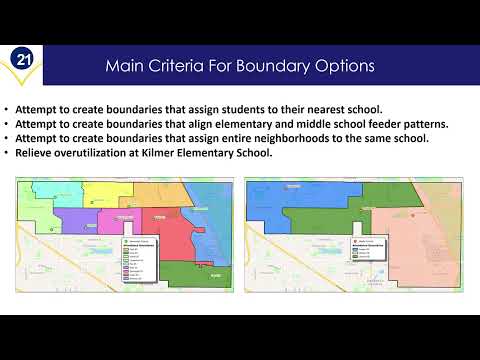
Wheeling CCSD 21 presented three proposed elementary and middle-school boundary maps intended to address overcrowding at Kilmer Elementary and rebalance school utilization across the district. The presentation outlined Options A, B and C and estimated they would affect roughly 410 to 748 elementary students, depending on the plan.
The presentation said the district currently serves 4,043 elementary students with a total program capacity of 4,678, giving a district-average elementary utilization of about 86%. "A goal of this redistricting process is to better utilize the existing elementary schools of CCSD21 to provide relief at Kilmer Elementary School," the presenter said.
Why it matters: Kilmer Elementary is the district's most overutilized school at about 113% capacity under current boundaries. The three options differ in scope and trade-offs: Option A seeks to limit the number of students moved while reducing Kilmer to roughly 83% utilization (about 410 elementary students reassigned); Option B moves more students (about 703) to bring most elementary schools within three percentage points of the 86% district average; and Option C proposes broad, district-wide adjustments that would affect the most students (about 748) but aims to keep each elementary site at or under roughly 90% utilization.
Option details: Under Option A, the district would reassign neighborhoods north of McHenry Road (Lexington Commons and Brookville) and several apartment complexes (Fairway Greens, Mandoline/Mandollay, Park Point) from Kilmer to Field Elementary, with additional localized shifts moving portions of Field to Twain and Whitman and some Twain areas to Tarkington and Frost. Option A also realigns middle-school service so reassigned Kilmer-to-Field areas would move from Cooper to London Middle School, and other moves preserve elementary-to-middle feeder continuity; the presentation estimated about 196 middle-school students would be affected.
Option B similarly targets Kilmer but expands changes in the district's east end, including the Arlington Club and Grove Terrace condominium areas and several apartment complexes, and would impact about 703 elementary students while improving balance across more schools; the presentation estimated 176 middle-school students would be affected under Option B.
Option C spreads adjustments across many elementary boundaries (including Longfellow, Poe and Riley) to achieve a more even districtwide balance, reducing Kilmer to about 90% utilization and affecting about 748 elementary students. Unlike Options A and B, Option C does not align all adjusted elementary boundaries with District 214 high-school attendance lines; Field and Riley would be split between the two high-school boundaries cited in the presentation.
Feeder patterns and middle schools: The district emphasized preserving elementary-to-middle feeder patterns in every option so students transition to middle school with their peers. Presenters reported the district's middle schools are near full capacity overall (about 98% utilization) but unevenly loaded: Cooper and London exceed 100% while Holmes is near 87%; proposed middle-school adjustments vary by option and would affect between roughly 158 and 196 middle-school students depending on the plan.
Public input and next steps: The presentation closed by directing the public to an online school-locator tool and an option survey available in English, Russian, Spanish and Ukrainian. Walpert (the consulting team named in the presentation) will collect and analyze survey feedback and share a final report with the CCSD21 boundary committee and the CCSD21 Board of Education before any formal recommendation.
The district did not take a vote during the presentation; the next procedural steps are the public comment period and survey analysis that the committee will use to refine any recommendation for the board.