Get Full Government Meeting Transcripts, Videos, & Alerts Forever!
Get email alerts on the Land Use Rezoning topic
No spam. Unsubscribe anytime.
Port Orange council approves rezoning and plan amendment for 56.53‑acre site after stormwater debate
Summary
The Port Orange City Council approved two second‑reading ordinances to change the future land use and zoning of a 56.53‑acre parcel to allow low‑density single‑family development, while residents and experts warned the site is hydrologically fragile and urged more stormwater safeguards.
The Port Orange City Council voted to approve a comprehensive plan amendment and a companion rezoning that cover approximately 56.53 acres north of Charles Street and west of Airport Road, moving the property to a rural transition future‑use designation and R‑20SF zoning.
At second reading, council members approved Ordinance 2026‑2 (comprehensive plan amendment) and Ordinance 2026‑3 (rezoning) after public hearings and debate over stormwater capacity and the timing of a Spruce Creek basin study. The council approved the plan amendment on second reading by a 4‑1 roll call and the rezoning on second reading by a 3‑2 roll call.
City staff said the package includes a density control — council adopted a one‑unit‑per‑acre limit as part of the motion on first reading that carried through to final consideration. The city manager told the council that the item combines a large‑scale comprehensive plan amendment and zoning and that the one‑unit‑per‑acre density cap had been included before transmittal to state review.
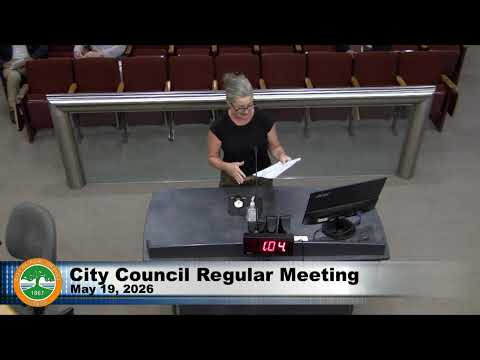
Several residents and technical witnesses urged the council to delay or impose stronger conditions. Jan Albert, who identified herself as an appraiser and hydrologist with more than five decades of experience, said the parcel is "hydrologically very fragile" and argued that even the lower density is not enough without specific low‑impact construction measures. "You're going to have 25 million gallons going for into the creek with each 4‑in rain event," she said, and recommended stem walls, cisterns, dry wells and vegetative controls to meet Volusia County Chapter 50 and state requirements.
Other speakers echoed concerns about the Spruce Creek system, calling for legally binding guarantees that post‑development runoff volumes and discharge rates be maintained at pre‑development levels. Residents said the county basin study is delayed and expressed skepticism about relying on older modeling data.
Supporters of the revised plan told council the developer substantially reduced the previous proposal (from about 111 homes earlier in the entitlement process to roughly 49–50 homes in the current plan) and argued the lower density and other concessions made the project acceptable. One resident said the reduction and the current approach preserve a rural character while allowing development.
Council members debated the city’s one‑year moratorium policy for development changes; some argued the ordinance allows applicants to return with materially different proposals and that the current application is significantly different from earlier submissions. Others said optics and community trust supported a delay.
On the record votes, the clerk recorded: Ordinance 2026‑2 passed on second reading (roll call recorded as: Councilman Foley — No; Councilman Gaffney — Yes; Councilman Green — Yes; Vice Mayor Grubbs — Yes; Mayor Sullivan — Yes; result 4‑1). Ordinance 2026‑3 passed on second reading (roll call recorded later as: Councilman Foley — No; Councilman Gilbert — Yes; Councilman Green — Yes; Vice Mayor Grubbs — No; Mayor Stahlnaker — Yes; result 3‑2).
The transcript does not specify final effective dates or conditions beyond the one‑unit‑per‑acre density limit shared during the motion. Several residents asked that implementation be tied to completed, current basin modeling and to legally enforceable stormwater measures; council discussion acknowledged those concerns but proceeded to adopt the ordinances as presented.
Next steps: the ordinances are final on second reading as recorded in the meeting; any required transmittals, permit reviews or development permits will proceed according to city procedures and state requirements, and several residents indicated they expect the city and developer to work on stronger low‑impact development measures as plan details are finalized.