Get Full Government Meeting Transcripts, Videos, & Alerts Forever!
Get email alerts on the Juvenile Rehabilitation Master Plan topic
No spam. Unsubscribe anytime.
DCYF presents juvenile rehabilitation master plan; Mission Creek emerges as preferred site to ease Green Hill overcrowding
Summary
Department of Children, Youth, and Families (DCYF) officials presented a 6–10 year Juvenile Rehabilitation master plan draft, citing an ADP near 430 and crowded conditions at Green Hill School. Mission Creek was identified as the preferred option to create a medium-security facility of up to 50 single rooms to meet a legislative 2029 operational target.
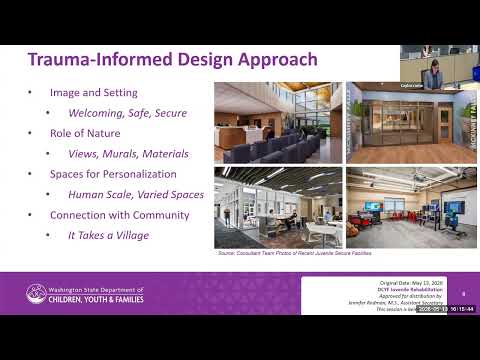
The Department of Children, Youth, and Families’ Juvenile Rehabilitation (JR) leadership outlined a 6–10 year master plan draft and a set of guiding principles at a public listening session, saying the plan will prioritize trauma-informed design, right-sized bed types and program space built around changing population needs. “Our goal for the master plan is to provide a roadmap for DCYF over the next six to 10 years,” Jennifer Redmond, Assistant Secretary for Juvenile Rehabilitation, told attendees.
Redmond and the design team walked participants through population data and capacity trends. Presenters said Washington’s average daily population (ADP) for JR was about 430 during 2025 and stressed that peaks matter for safe operations as much as averages. Green Hill School has at times operated above its stated safe operating capacity and, according to presenters, requires reconfiguration of large housing units into smaller, trauma-informed living units with single bedrooms and program space.
The team emphasized guiding principles for new or renovated JR facilities: trauma-informed interiors, single-occupancy rooms where possible, smaller housing units (a 16-bed “sweet spot” was cited), flexible spaces that allow step-downs in security without major renovation, and improved workplace safety to support staff retention. Presenters cited national standards they are using as touchstones, including performance-based standards and the National Commission on Correctional Health Care.
Legislative changes expanding juvenile jurisdiction were a recurring theme. Redmond noted state actions (SB6160 and HB1626) that allow some people convicted under age 18 to remain in juvenile jurisdiction through age 25; speakers said that statutory change has increased the cohort of older youth whose program and housing needs differ from younger adolescents.
Site selection work identified Mission Creek — a former DOC women’s facility and former JR camp — as the most viable option among several sites evaluated to meet a legislative direction to identify a facility that could be operational by 2029 and serve 50 or fewer young people. Presenters described Mission Creek’s appeal as including existing infrastructure and community relationships; the pre-design envisions renovating two living units to provide no more than 50 single-bed rooms and program, visitation, medical and education space. “We would not operate it [Mission Creek] like a DOC campus,” Redmond said, and said responsibility would sit with DCYF if the legislature directs the shift.
Operational details for Harbor Heights and other campuses drew extensive public questions. Harbor Heights has 48 rooms but presenters said it is healthiest around 28–32 residents because of limited program space; Echo Glenn’s recent upgrades brought its capacity from about 120 toward 132 and Green Hill’s safe operating capacity was cited around 180. Presenters also described Community Transition Services (CTS), an electronic-home-monitoring option that was expanded by recent legislative funding and that will require additional 24-hour staff support after July 1.
Attendees pressed officials on programming and equity for small populations: females comprise roughly 6% of JR custody, presenters said, which complicates providing dedicated gender-responsive services in place. Officials discussed options including a standalone female facility, rotating virtual college courses, and partnerships to deliver vocational and educational programming. Participants and a Judge attending the session also urged considering prison pet programs and extended family visits as therapeutic options; officials said similar pilot programs already exist in some JR campuses and adult facilities and that such ideas are on the table.
On transfers and long-term stays, presenters said about 14 youth had self-requested transfer to the Department of Corrections and six transfers occurred for cause; reasons included long stays, seeking work-release opportunities earlier, or wanting a different path than remaining at Green Hill. Staff acknowledged the challenge of keeping youth with multi-year lengths of stay engaged in JR programming and said program diversity and appropriate medium-security spaces are part of the long-term response.
The design team emphasized that program decisions for any new site would be informed by youth voice, staff input and community engagement rather than set unilaterally. Next steps include compiling session feedback into the consultant summary, distributing a follow-up survey (QR code provided during the session), and completing a master plan by fall of the year, with a separate feasibility study due on an eastern Washington secured facility as directed by the legislature.
The session closed with a call for survey responses and ongoing engagement; presenters thanked online and in-person attendees and reiterated that survey results would inform the next iteration of recommendations.