Get Full Government Meeting Transcripts, Videos, & Alerts Forever!
Get email alerts on the Street Trees topic
No spam. Unsubscribe anytime.
Oregon City Commission reviews street-tree code, considers fines up to $25,000
Summary
City staff proposed code edits and two fee models for street-tree removals, including enhanced penalties (for heritage trees, large trunks and certain zones) that could push fines toward a $25,000 cap. Commissioners directed staff to clarify definitions, fix inconsistent permit language and return with a revised ordinance and fee schedule.
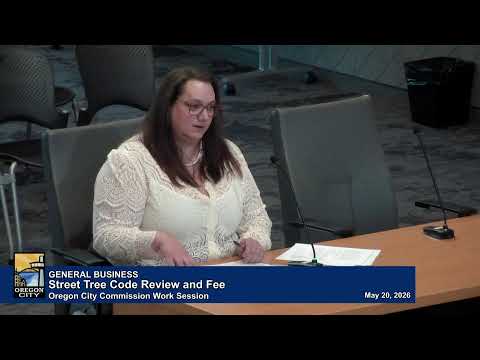
Oregon City commissioners spent their May 20 work session reviewing proposed amendments to the city—ode that would tighten enforcement of street-tree removals and raise civil-infraction fees to create a stronger deterrent.
Kelly Hart, community development director, presented staff rafts that would amend Chapter 1 (civil-infractions fee) and Chapter 12 (street-tree code), cross-reference Chapter 17 definitions, require a tree-removal permit for any street-tree removal and set a two-tier penalty structure. Hart said the draft includes a standard increased civil-infraction and additional "enhancements" for factors such as trees larger than 24 inches in diameter, heritage trees and trees in targeted mixed-use zones or the Willamette River greenway; the enhanced structure was presented as one option that could cap at about $25,000.
Why it matters: Staff told the commission that the existing penalty structure does not deter unlawful removals. Commissioners said the city needs clearer rules and enforcement if it expects contractors and property owners to preserve the urban canopy.
In the presentation, Hart outlined two fee models. One places violations into size-based tiers with a single maximum for enhanced cases; the other sets a base fine by tree-size tier and then adds a fixed enhancement amount for each qualifying factor (staff showed an example in which a 40-inch tree could carry a $15,000 base fine plus $5,000 per enhancement). Hart asked the commission whether to proceed with code amendments as drafted, which fee structure the commission preferred and whether the commission wanted an upper cap on added enhancements.
Staff also flagged inconsistent code wording in Section 12.08.035 E2 that appeared to allow some removals "without a permit." Commissioners and staff agreed to correct that language so the code would require a permit for all street-tree removals while still exempting narrow planter strips (3 feet or less in width) from replacement or mitigation obligations.
Sean (staff member), who said he had spoken with the municipal judge, advised the commission that judges retain the ability to modify enhancement penalties in specific cases. "She can modify the enhancements," Sean said. Several commissioners voiced concern that broad judicial discretion could undercut the commission's goal of creating a meaningful deterrent. Commissioners asked staff to check whether the commission could set a non-reducible minimum penalty that a judge could not drop below.
Commissioner Mitchell and others expressed a preference for the tiered approach that applies $5,000 increments per enhancement because it specifically targets removals in high-priority zones rather than relying solely on a single, highly variable cap. Commissioners also pressed staff to define "tree well," to clarify the planter-strip exemption and to fix E2 so that a permit is always required (even when no mitigation will be required for very narrow planter strips).
Asa (staff member) summarized the agreed next steps: define "tree well," revise Section 12.08.035 E2 to remove the apparent "without a permit" language, and advance the preferred fee structure (standard fee plus $5,000 per enhancement) for formal ordinance drafting and a resolution to come back to the commission.
No formal votes or ordinance adoptions occurred during the session; staff will return with revised code language and a proposed resolution. The commission recessed at the end of the work session.