Get Full Government Meeting Transcripts, Videos, & Alerts Forever!
Get email alerts on the Budget topic
No spam. Unsubscribe anytime.
LAUSD staff: May Revision gives one‑time relief but district still faces multi‑billion deficit; board to preview fiscal stabilization plan
Summary
District financial staff told the board that while the governor’s May Revision increases Prop 98 and proposes a 4.31% 'super COLA' and one‑time grants, LAUSD still projects large multi‑year deficits and will present a fiscal stabilization plan for board approval in June.
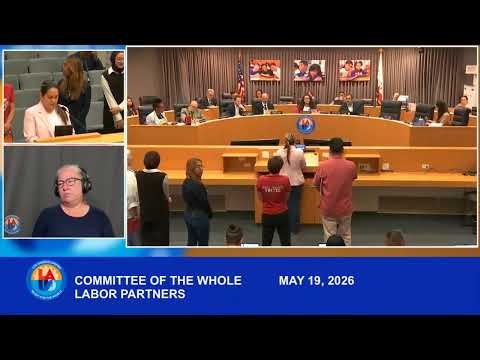
Los Angeles Unified officials told the Committee of the Whole on May 20 that the governor’s May Revision raises the Prop 98 three‑year guarantee and proposes a higher cost‑of‑living adjustment (a 4.31% 'super COLA') plus one‑time block grants, but that the district will still face large multi‑year budget shortfalls without additional action.
“We continue to be concerned about the almost $4 billion that is being withheld in terms of Prop 98,” Acting Superintendent Chait said, urging continued advocacy in Sacramento to avoid withholding funds intended for today’s students. Chief of Legislative Affairs Martha Alvarez summarized key changes in the May Revision, including deposits required to the Prop 98 reserve and new competitive grant pots for literacy coaches and homeless student services.
Chief Financial Officer San Bravo Karimi presented updated district estimates. He said the super COLA would raise LAUSD’s ongoing baseline revenues (the district’s approximate share produces an ongoing benefit that staff estimated at about $112 million annually), and May Revision one‑time proposals would add substantially to 2026‑27 revenues (the district’s estimated share of a proposed $5 billion discretionary block grant was cited at roughly $328 million). The CFO cautioned that most of those one‑time revenues are not yet final and that the district may include some of them only in a fiscal stabilization plan rather than in the official multi‑year projection.
Even after modeling the proposed state revenues, staff presented a preliminary multi‑year projection that showed a sizeable negative unrestricted general fund balance by 2028‑29 (a staff figure presented at the meeting showed roughly a $3.6 billion projected shortfall in the baseline scenario). The district plans to present an updated fiscal stabilization plan to the board in June; two key upcoming board calendar items are a June 16 hearing and vote on the fiscal stabilization plan and collective bargaining agreements, followed by budget and LCAP action on June 23.
Board members asked for timelines on retroactive pay recognition, the size and timing of Reduction‑in‑Force authorizations and how proposed state proposals (like a paid pregnancy disability leave) will affect district costs. Staff said retropay for the 2024‑25 and 2025‑26 bargaining agreements will be recognized as expenditures in 2025‑26 and reiterated that the new fiscal plan must identify additional reductions for 2027‑28 and 2028‑29 given current projections.
What’s next: the board will preview the district’s draft fiscal stabilization plan at a subsequent meeting and is scheduled to vote on adoption and related collective bargaining assurances in mid‑June.