Get Full Government Meeting Transcripts, Videos, & Alerts Forever!
Get email alerts on the Academic Policy topic
No spam. Unsubscribe anytime.
School board considers new promotion and retention policy emphasizing early intervention
Summary
Board reviewed a substantially revised promotion-and-retention policy that emphasizes multiple criteria, early identification, MTSS interventions, and expanded summer programming rather than single-test retention. Staff and board debated which details belong in policy versus regulation; staff will provide comparison documents and research cited.
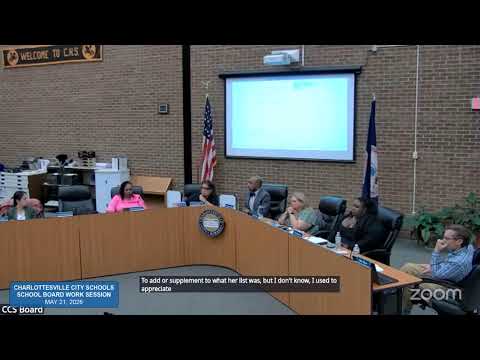
The Charlottesville School Board reviewed a proposed rewrite of its promotion-and-retention policy after staff and board members said the existing policy had not been substantively updated since 2008.
The draft emphasizes multiple criteria—academic performance, developmental needs, attendance and response to targeted interventions—rather than relying on a single test score. Staff and board members repeatedly cited research that retention as a standalone intervention can have negative long-term outcomes and stressed that early identification, high-dosage tutoring, and robust summer programming are evidence-based complements to promotion decisions.
Board members debated policy text versus regulation details. Several members said the board should set clear expectations in policy (notice requirements to parents and standards the board expects) while leaving implementation criteria and procedures (exact thresholds, appeals, and attendance definitions) to regulation and building-level MTSS teams. Staff said the draft had been vetted with executive leadership, principals, and instructional coordinators and agreed to provide comparative examples from other divisions and the research the team used.
Staff reported the majority of current retentions at the K–6 level occur in K–3, consistent with an emphasis on early reading and literacy interventions. The board asked staff to return with more granular data—how many retentions were initiated by schools versus parents, distribution by grade, and whether responses to interventions are being implemented with fidelity.
The board took no final vote on the policy; members signaled they want some core expectations codified and asked staff to refine the draft and supply the comparative materials and research citations for a future meeting.