Get Full Government Meeting Transcripts, Videos, & Alerts Forever!
Get email alerts on the City Budget CIP topic
No spam. Unsubscribe anytime.
Deltona kicks off FY27 budget workshop, staff outlines roughly $35 million in capital requests and funding options
Summary
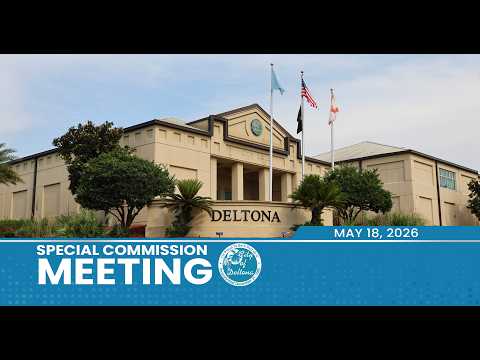
City staff told the Deltona City Commission May 18 that roughly $35 million in capital improvement requests will be considered during the FY27 budget workshops, and outlined options including impact-fee updates, a fire assessment model and debt financing; public breakouts were held to gather input.
Deltona staff opened the first fiscal-year 2026–27 budget workshop on May 18 with an overview of capital-improvement priorities and preliminary funding baselines.
John, a staff presenter, told the commission the materials in binders and the tabletop format were intended to give commissioners one-on-one time with department representatives. "We roughly have $2 million annually available for stormwater," he said, and "roughly $3 million available from local option gas tax" for streets and sidewalk work. He said the packet contained about $35 million in capital-improvement requests across departments.
Why it matters: The workshop begins the formal review of projects that could lead to rate or assessment changes, debt issuances or impact-fee adjustments that affect property owners, development projects and city service levels. Staff emphasized many projects depend on interagency revenues, finalized fee and rate studies and the city's millage-setting schedule.
Staff described the workshop format and next steps: breakout tables staffed by department representatives, seven minutes per table while commissioners rotate, and follow-up materials posted online. John said staff expect fee- and rate-study results in late June to early July and that final millage decisions will follow the statutory schedule.
Funding details and constraints: Staff characterized the CIP categories and gave numerical examples: about $6.35 million in capital replacements and $617,000 in requested enhancements were included in the package. Departmental requests cited by staff included parks ($4 million), transportation ($5.5 million), water/wastewater ($6.5 million) and stormwater (just under $18 million over the next two years). John said some projects may require financing and noted choices under consideration included impact fees, a fire assessment model, general-obligation bonds or bank loans.
Special assessments and fees: Staff outlined specific local proposals and known cost pressures. The current stormwater assessment is $190 per year; mailings indicate a proposal to move that assessment to $210 next year. Solid-waste assessments are currently $235 per year and staff reported the county landfill tipping fee recently increased by 7.98 percent. John said the city will examine whether some services could be offset by fees billed to insurance (for certain emergency responses) and that not all revenue sources can be placed into every funding model (for example, certain transport fees cannot be included in a fire-assessment model).
Impact-fee schedule and state context: Staff said they plan two public workshops on impact fees (a morning session on June 8 and an afternoon session on June 15), with a first reading of an ordinance on June 15 and a second reading on June 22, to have updates in place before July 1. John warned commissioners that proposed state changes to impact-fee rules could limit how large one-time increases can be implemented; he referred to House Bill 1329 as a pending change that would cap or alter the phasing of large increases.
What happens next: Staff will compile commissioner questions into a crosswalk and FAQ, post workshop materials, and return to the commission in June and July with updated rate and fee analyses and a proposal for the fire-assessment model and related ordinance work.
At the time of the presentation, staff emphasized that the numbers were preliminary and contingent on the outcomes of fee studies, the millage-setting process and negotiations over potential financing. The commission paused the workshop for the public breakout sessions and scheduled reconvening at 8:00 p.m.