Get Full Government Meeting Transcripts, Videos, & Alerts Forever!
Get email alerts on the Water And Sewer Rates topic
No spam. Unsubscribe anytime.
Ellensburg considers phased water and sewer rate increases and higher connection fees to fund $90M+ capital plan
Summary
The council heard a presentation from FCS Group recommending a three‑year phase‑in of water and sewer rate increases (roughly 3% annually for water, about 11–12% for sewer) and staged raises to plant investment (connection) fees to fund major upcoming capital projects and avoid exhausting reserves.
Ellensburg City Council heard a presentation from the FCS Group on proposed increases to water and sewer rates and one‑time plant investment fees designed to fund multi‑year capital plans.
"Our utilities need to operate as their own businesses," the meeting Chair said, framing the discussion around cost‑recovery by customers rather than use of general fund revenues.
Sergey Terasov of FCS Group told the council the firm ran a revenue‑requirement analysis and rate‑design study using a six‑year planning horizon (2026–2031) with longer‑range capital projections through 2044 to avoid a later funding cliff. Terasov said the study assumes modest annual growth (about 1–1.5% for water, about 2% for sewer), an inflation range near 3.1–3.2% and placeholder bond assumptions for planning purposes.
The study projects water system revenues under current rates at about $6.9–7.4 million annually and forecast operating expenses that trend toward roughly $6.1 million; FCS estimated the six‑year water capital program at about $38 million (inflated). For sewer, FCS projected revenues of about $6.1–7.2 million and a six‑year capital program near $53.6 million, with additional large treatment projects identified beyond the six‑year window.
FCS recommended a phased approach: the Environmental Commission favored a three‑year implementation that would smooth rate impacts and allow staff and the commission to revisit assumptions midway if grant opportunities or other changes materialize. Under the proposal discussed, the council would consider a mid‑2026 adjustment (the first for 2026) and then move to January annual adjustments thereafter.
Terasov summarized recommended directional changes: roughly a 3% annual inflationary adjustment for water and approximately 11–12% spread over the three‑year period for sewer (as presented). He emphasized that the utilities are enterprise funds and that rates, plant investment fees and targeted borrowing would be the primary tools to implement the capital plans.
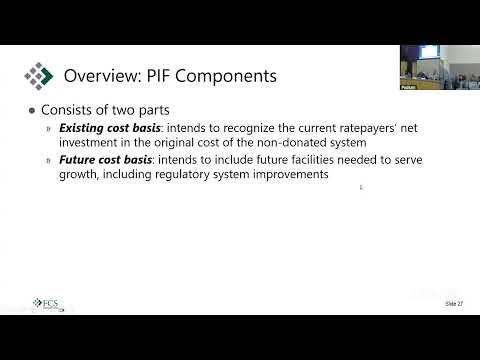
On one‑time plant investment fees (connection charges), FCS presented maximum allowable calculations based on existing and future capacity cost bases. For sewer, the study produced a maximum allowable charge of about $15,242 for the base meter size (compared with the current base charge reported as $5,680). For water, a combined charge calculation produced roughly $11,900 for the base meter size (up from a current figure presented as $6,160). In both utilities the commission recommended phasing those fees over three years starting in 2027 rather than adopting the maximum immediately.
Councilmember Delano Palmer asked whether the plan accounts for the large projects projected in 2032–2033. "Does any of this projection take into account covering some of those capital costs?" Palmer asked. Terasov replied that the forecast does anticipate future bond issuances and that the analysis included a larger issuance in the 2032 timeframe (described in the presentation as on the order of tens of millions) so the strategy aims to avoid an immediate cliff by phasing and planning multiple bond series.
David, speaking as liaison to the Environmental Commission, said commission members found the decision difficult but ultimately recommended the phase‑in in the hope that grants or lower costs might reduce the ultimate increases: "No one wants to see rates go up but there was the recognition that we have to invest in the infrastructure in order to keep things working."
The presentation noted potential funding sources beyond rates: an estimated portion of the water plan (about $5.9 million) could be covered by plant investment fees, some projects may attract grant proceeds (the presenter referenced an aquifer storage/recovery project tied to grant funding), and the remainder would be funded via reserves, rates or future borrowing. FCS warned that under a baseline of no action reserves would be drawn down and the city might lack cash to implement the full capital plan within the six‑year window.
No formal council action was taken during the presentation. Staff said there is a draft ordinance forthcoming and Sergey Terasov would be available during the council’s later ordinance discussion. The council adjourned to convene the regular meeting at 7:00 p.m., when the rate ordinance and related materials are scheduled for further consideration.
Sources: Presentation by Sergey Terasov, FCS Group; comments from the council Chair, Councilmember Delano Palmer and Environmental Commission liaison David (as recorded in the meeting transcript).