Get Full Government Meeting Transcripts, Videos, & Alerts Forever!
Get email alerts on the Discipline Policy topic
No spam. Unsubscribe anytime.
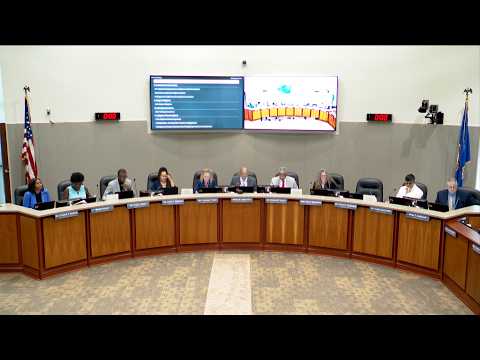
Board adopts 2026–27 Code of Behavior after debate over enforceability and discipline
Summary
Prince William County School Board approved the 2026–27 Code of Behavior (vote 6–1–1); public commenters urged stronger enforcement for bullying and discipline while some board members said state law constrains local discipline options.
The Prince William County School Board voted on May 20 to adopt the proposed 2026–27 Code of Behavior after extended discussion and public comment. Board members recorded the final tally as six yes, one no (Wilk), and one absent (Trudnak).
The measure, moved by Vice Chair Jessie and seconded by Ms. Williams, includes updated definitions for fighting, assault and battery, and substance-distribution; explicit language about artificial-intelligence-related misconduct; clarified homework and late-work expectations; and a framework aligned with applicable state and federal law. Dr. McDade and Dr. Sampson defended the revisions as consolidation of regulations and noted the effort to reduce redundancies across multiple documents.
Public commenters raised contrasting concerns: several parents and community members urged firmer consequences and expressed support for coaches and staff they said are improving school climate, while other speakers—particularly parents of students with disabilities—raised serious concerns about the district’s compliance with IDEA and ADA obligations. During public comment Dr. Kimberly Milman Orosco urged federal review, saying, “I am calling on the Department of Justice. I am calling on the US Department of Education. I am calling on the Office of Civil Rights to investigate this board” for alleged systemic violations (public comment period).
Board discussion acknowledged competing priorities. Some members said changing state law and legal constraints limit the division’s ability to impose certain disciplinary measures; others emphasized the code’s role as a living document to be refined through implementation, monitoring, and professional learning. The motion to adopt passed; the code will be posted and implemented as the division’s official conduct and discipline regulation for 2026–27.