Get Full Government Meeting Transcripts, Videos, & Alerts Forever!
Get email alerts on the Land Use topic
No spam. Unsubscribe anytime.
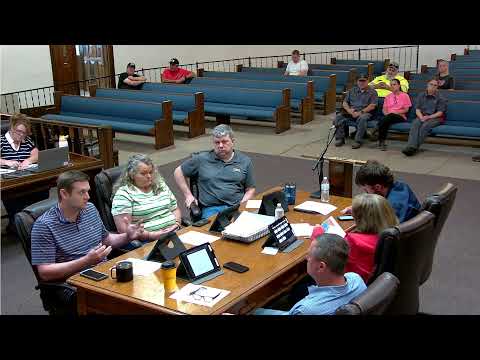
Fiscal Court weighs options for regulating data centers without countywide planning and zoning
Summary
Logan County commissioners discussed directing staff to explore ordinances or regulatory approaches targeting water-intensive businesses such as data centers, while county legal counsel cautioned that a data-center-specific ordinance could be legally vulnerable without broader planning and zoning authority.
Logan County Fiscal Court spent significant time discussing how the county might respond to interest from large facilities — including data centers — in the absence of countywide planning and zoning.
A court member (speaker 3) said residents are concerned about siting large, resource-intensive facilities near homes and proposed considering an ordinance aimed at data centers to give the public a chance for input. An agency official/legal advisor (speaker 13) responded that state law has allowed counties specific authority over some uses (for example, solar farms in certain circumstances) but that a data-center-specific ordinance would likely be vulnerable to legal challenge if it attempted to directly ban data centers without broader zoning authority. Instead, the advisor recommended focusing on regulation of the dependent inputs (notably water) and suggested consulting KRS 67.83 (county powers) and related subsections to craft a regulation that addresses water and resource impacts for businesses that consume large quantities of water.
Court members discussed outreach to water districts and regional suppliers and the possibility of drafting a more broadly scoped ordinance that would regulate high-water-usage businesses rather than naming data centers specifically. Several members urged caution and recommended further legal and policy research before drafting any ordinance.
Why it matters: with no countywide planning and zoning in place, residents have limited formal recourse through land-use hearings; the court’s discussion signals an intent to explore regulatory avenues that could protect water supplies and community character while staying within the county’s legal authority.
Court staff were directed to gather further information, coordinate with water providers and return recommended options to the court for consideration.