Get Full Government Meeting Transcripts, Videos, & Alerts Forever!
Get email alerts on the School Report Card topic
No spam. Unsubscribe anytime.
Minooka 201 highlights gains on 2025 Illinois School Report Card, flags early‑learning readiness gaps
Summary
District presenters told the board that Minooka 201 outpaced state averages on several growth measures, with district ELA and math growth above state figures, while early‑learning readiness lags state averages; presenters described classroom interventions and curriculum purchases to address a recurring third‑grade assessment dip.
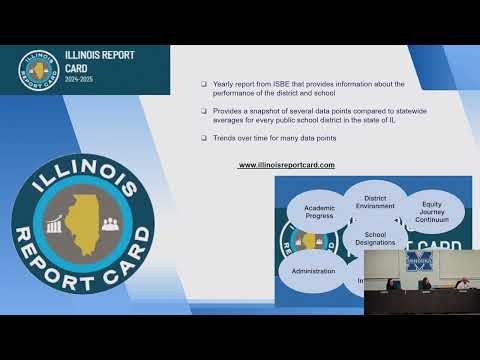
District leaders gave the board a detailed preview of the 2025 Illinois School Report Card and related local data, emphasizing year‑over‑year growth and some persistent early‑learning gaps.
The presentation noted that Minooka’s district proficiency snapshots exceed state averages in several areas: the transcript cites district ELA proficiency of 56.3% compared with the state’s 52.4% and district math proficiency of 42.5% vs. the state’s 38.4%. Presenters also highlighted that two elementary schools reached an exemplary summative designation while others were rated commendable.
At the same time, presenters called attention to early‑learning readiness measures that trail the state: social and emotional readiness was reported at 44.8% in the district versus 58.7% statewide, and language and literacy readiness was 37.6% districtwide versus a 49.5% state average. The district acknowledged these areas require targeted outreach and partner engagement.
Presenters explained a recurring "third‑grade dip" in assessment percentiles: MAP/NWEA renorming and the greater independence required by third‑grade assessments help explain the movement in percentiles. To address gaps, the district said it has purchased the Foundations Level 3 resource to bolster third‑grade decoding and phonics skills and is using targeted ELA supports, PLC work, and small‑group instruction.
The business and academic presentations also compared district resources and outcomes: Jones Elementary’s instructional spending per pupil was cited at $14,340 and Walnut Trails Elementary at $15,238, with a district average close to $14,000 per pupil; presenters noted the district’s equalized assessed value is smaller than several comparators (district EAV stated as $305,800,000 versus a comparator average about $416,000,000), which constrains resources.
Superintendent/Moderator and Mrs. McCarroll emphasized that growth is the largest component of the state’s summative designation and praised school teams for progress while noting continued focus areas and next steps in curriculum, family engagement, and targeted interventions.
The presentation will feed into building‑level school improvement plans and future strategic updates to the board.