Get Full Government Meeting Transcripts, Videos, & Alerts Forever!
Get email alerts on the Humanitarian Crisis topic
No spam. Unsubscribe anytime.
UN spokesperson summarizes mounting humanitarian crises and cites concern over school strike in Starobilsk
Summary
UN spokesperson Farhan summarized multiple humanitarian crises — reporting major air attacks in Ukraine including a strike near a college in Starobilsk, mass displacement in Lebanon, restricted crossings into Gaza, an Ebola outbreak in the DRC, and drone attacks in Darfur — and reiterated calls for protection of civilians and increased aid.
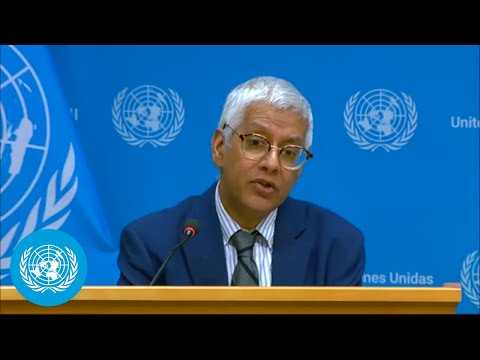
Farhan, the United Nations spokesperson, told reporters that the Secretary‑General warned the UN Charter is under “profound strain” and quoted him saying “the United Nations Charter is a survival guide for humanity,” citing recent announcements of strikes on Ukrainian targets and a reported drone attack on a college building and dormitory in Starobilsk.
Why it matters: The briefing framed multiple, simultaneous crises — in Ukraine, Lebanon, Gaza, the Democratic Republic of the Congo and Sudan — as part of a broader trend that the Secretary‑General said risks prolonging civilian suffering and undermining diplomatic efforts.
The spokesperson said that OCHA reported one of the largest combined air attacks on Ukraine since 2022 over the weekend, with scores of civilian casualties and extensive damage to civilian infrastructure in Kyiv and neighboring regions. He cited a Kyiv attack that killed at least two people and injured nearly 90 others, including children, and described widespread destruction to residential buildings, markets, a subway station and cultural sites.
Citing partners, Farhan said humanitarian teams provided psychosocial support, legal assistance and emergency supplies in affected areas, and that an incident involving a drone near UN offices damaged windows and a WHO office but did not injure aid workers. He added that between January and April at least 62 incidents affecting humanitarian personnel, vehicles, supplies and facilities were recorded.
On Lebanon, the spokesperson said OCHA estimates nearly 1 million internally displaced people remain; he described families sheltering in vehicles in Beirut, new evacuation orders for Nabatiya and Mashkara, and extensive military activity observed by UNIFIL — including hundreds of firing incidents, airspace violations and drone explosions near UN positions.
Turning to the occupied Palestinian territory, Farhan said the Zakkim crossing would remain closed this week and Kerem Shalom/Kerem Abu Salem was the only operational cargo crossing, and he renewed calls for more crossings and regular access for critical supplies such as backup generators and fuel.
On Gaza’s water and sanitation needs, the briefing quoted partners estimating roughly 7,000 liters of engine oil are required monthly to sustain operations for water and wastewater systems; shortages, he warned, have forced shutdowns of key infrastructure and raised flood and public‑health risks.
The spokesperson also reported WHO figures on an Ebola situation in the Democratic Republic of the Congo — “more than 900 suspected cases and 220 suspected deaths,” he said — and noted WHO Director‑General Dr. Tedros Adhanom Ghebreyesus planned to travel to the country. He added that violence and limited access continue to impede the response and that funding and safe access remain urgently needed.
Farhan closed the summary by noting the UN envoy for Sudan, Pekka Havasto, is engaging parties with QUINTET partners to prepare for an inter‑Sudanese civilian dialogue, and by expressing continued calls for parties everywhere to protect civilians and civilian infrastructure in line with international humanitarian law.
The briefing moved to a reporter Q&A after these updates; no formal UN action was taken during this session.