Get Full Government Meeting Transcripts, Videos, & Alerts Forever!
Get email alerts on the Road Infrastructure topic
No spam. Unsubscribe anytime.
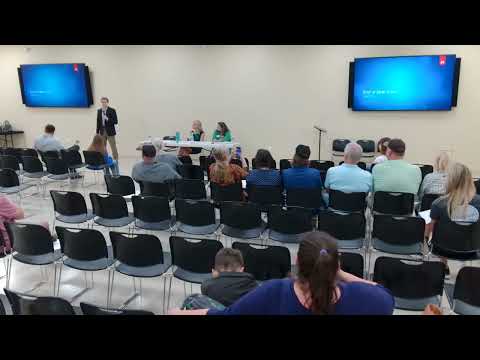
Engineers outline Squaw Creek Road widening and waterline replacement at Willow Park town hall
Summary
Jacob Martin Engineers presented plans to widen side streets to 20 feet, replace aging waterlines with 6-inch pipe, and pursue either concrete or asphalt options for Squaw Creek; timeline estimates 1–2 months to finish design, months for procurement, and about a year for construction.
Jacob Martin Engineers presented detailed plans Thursday night at a Willow Park town hall for the Squaw Creek Road waterline replacement and side-street reconstruction, saying the project would widen most side streets to a 20-foot pavement width and replace deteriorated waterlines with new 6-inch pipe.
Thomas, a project engineer with Jacob Martin Engineers, told residents the side-street package covers Mesa Road, Verde Road, Cactus Road, Cactus Court and Faraday Road and that the current pavement in places narrows to about 15 feet. “We’re going to widen the road to be 20 ft wide,” he said, adding that the changes are intended to allow two vehicles to pass safely and reduce safety risks where the pavement is too narrow.
The presentation emphasized that the work is primarily a roadway reconstruction project, not a drainage project. Engineers said they will limit off‑pavement impacts by tying into existing side slopes where possible and not exceeding a three-to-one side slope without explicit need. The team also described safety constraints driven by K‑values (vertical curvature) and said they will try not to increase driveway slopes; grade breaks will be kept at or under 14 percent where feasible to reduce the risk of vehicles bottoming out.
On materials, the city will solicit bids for both concrete and asphalt options for Squaw Creek. Thomas said the city prefers concrete if pricing is competitive because concrete typically offers a longer service life; Nick Kirk of Jacob Martin Engineers said concrete commonly lasts 35–50 years when properly constructed and maintained. If concrete pricing is substantially higher, the city may choose asphalt with concrete ribbon curb to extend asphalt life, the engineers said. The presenters confirmed that the side streets themselves are planned as asphalt.
The engineers outlined the proposed pavement section for reconstructed streets as about 8 inches of base with 2 inches of surface asphalt (Type E) and stated that, if maintained, pavement sections typically have an expected life of about 20 years.
Thomas also said the waterlines in the side streets are deteriorated and that the plan currently calls for 6‑inch waterline replacement throughout those streets. Residents asked whether individual mailboxes damaged by construction would be replaced; Thomas said any mailbox touched or demolished by the contractor would be restored “just as good, if not better.”
On project timing, Jacob Martin Engineers presented a rough schedule: one to two months to finalize design and secure city approvals, five to six months to complete funding steps and the bidding/award process, and roughly one year for construction once the contractor mobilizes. Engineers said sequencing of work (whether the contractor starts on Squaw Creek or the side streets) is typically determined by the contractor’s mobilization plan, though the city and engineers can request a preferred order and will notify residents when plans are set.
City communications staff said meeting materials — including the presentation, project maps and a written meeting summary — will be posted on the project page at willowparktx.gov and that a consolidated Q&A based on questions from the night will be published and updated online. Residents were asked to sign a contact sheet so staff can set up one-on-one property reviews and follow up on site-specific questions.
On funding, a resident asked whether work would begin in the current fiscal year. Assistant City Manager Michelle Gker told the meeting that the fiscal-year budget for 2025–26 is approved and that the project will be financed through the city’s existing “INS service” (as stated in the meeting). The city did not provide further detail on what “INS service” refers to during the session; staff said they will circulate financing details as they are finalized.
Residents asked about adding fiber while roads are open. Michelle Gker said the city has explored coordination with internet providers but that provider deployment schedules often fall outside the project’s timeframe, so fiber installation is not guaranteed as part of this project; staff said they will continue to pursue options.
Several site-specific questions — including whether a fire hydrant/drainage outlet would need relocation and exactly how individual driveways will tie into the new grades — were redirected to the post-presentation one-on-one table so engineers can inspect property lines and document individual concerns before the design is finalized.
Mayor Palmer thanked staff and the engineers for the outreach format and invited residents to move to the exhibit tables to review maps and discuss driveway and access details one-on-one. City staff said they will post the presentation and a meeting summary online and update the Q&A as new questions come in.
Next steps: the project team will finish design (estimated 1–2 months), post financing and procurement milestones, produce bid documents, and host one-on-one meetings with affected property owners to record driveway and utility tie-in preferences before construction procurement.