Get Full Government Meeting Transcripts, Videos, & Alerts Forever!
Get email alerts on the Butner History topic
No spam. Unsubscribe anytime.
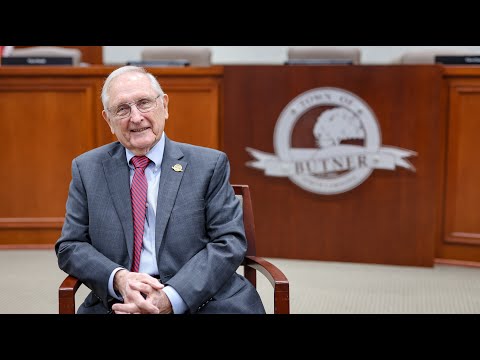
Former mayor Tom Lane recounts Butner's wartime origins and path to incorporation
Summary
Tom Lane, former mayor and current Butner council member, recounts how Camp Butner was established in 1942, how federal lands were transferred and reused after 1947, and how sewer, boundary and annexation disputes led to the town’s official incorporation in 2007. He also outlines major post‑incorporation projects and prospects for growth.
Tom Lane, former mayor and current council member of Butner, described in an interview how the town emerged from a World War II training base and later became an incorporated municipality in 2007.
Lane said the military selected the Grand Duressen site in the early 1940s and "by July of '42, a base that would accommodate about 35,000 troops was completed." He said the installation was called Camp Butner and was named to honor General Butner, a native of Forsyth County who died in 1937 while serving as commandant of the Panama Canal Zone.
The formation of Camp Butner reshaped local land ownership, Lane said. "The military took about 43,300 acres from the citizens of this area," he said, and after the war large portions were sold back while the state retained thousands of acres for institutional use. According to Lane, the North Carolina National Guard received about 5,700 acres now known as Camp Butner, while roughly 13,000 acres, including the hospital complex, remained under state control.
Lane told the interviewer the hospital played a central role in daily life after the base closed in 1947. He said the hospital’s business manager effectively acted as town manager, "and everything revolved around the hospital in the early days," with most residents employed there.
Pressure to incorporate grew decades later, Lane said, after efforts to upgrade the town’s sewer system met regulatory resistance tied to concerns about discharges to Falls Lake. He described a state-funded study—"I think they spent about $500,000"—and said a separate political dynamic with neighboring Creedmoor, which had declined to provide water to a developing area across U.S. 85, accelerated the push for town status. Representative Jim Crawford introduced the enabling bill; Lane said the legislation was effective in July 2007 and the town’s formal creation took place in November 2007.
Lane also described post‑incorporation investments. He said the town renovated the Soldiers Memorial Arena—built originally at a cost reported in town records as $80,000—with about $650,000 spent on renovation for lighting, electrical work and air conditioning. The town built a new town hall and developed Butner Athletic Park; Lane said the town borrowed to finance those projects but has since paid off the debts. "Both of those are all paid off now, free and clear," he said.
On future growth, Lane said he hopes Butner remains close-knit while expanding enough to support more local businesses. "I think we're poised for good growth," Lane said, adding that a larger population base would be needed to attract additional grocery stores and other amenities.
The interview closed with the moderator thanking Lane for sharing his recollections and perspective.