Get Full Government Meeting Transcripts, Videos, & Alerts Forever!
Get email alerts on the K12 Education topic
No spam. Unsubscribe anytime.
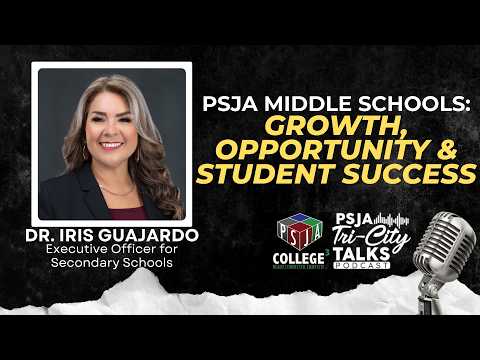
Dr. Iris Guajardo: PSJA’s middle schools use counselors, advanced courses and transition programs to prepare students for high school
Summary
Dr. Iris Guajardo, PSJA’s executive officer for secondary schools, said the district’s eight middle schools combine counseling, safety investments, advanced coursework (including high‑school credit) and summer bridge programs to ready students academically and socially for high school.
Dr. Iris Guajardo, executive officer for secondary schools at PHARR‑SAN JUAN‑ALAMO ISD, told the PSJ Tri City Talks podcast that the district’s middle schools blend academic rigor with student supports to prepare sixth‑ through eighth‑grade students for high school and beyond.
Guajardo said PSJA has expanded counseling and leadership staffing at middle schools and intentionally structures supports so students build stable adult relationships. “We have a counselor for every grade level,” she said, adding that counselors commonly follow students from sixth through eighth grade so each student knows at least one trusted adult on campus.
The district also emphasizes college pathways and accelerated coursework in middle school. Guajardo described advanced classes and high‑school credit offerings — Algebra I, geometry, Spanish and Career and Technical Education courses — that align with the district’s early college high school model. “We’ve embedded digital learning…we’ve honed a lot into rigorous instruction so that students are prepared for that college learning,” she said.
Guajardo highlighted the district’s teaming model, in which a small group of core teachers (math, language arts, science, social studies) work with a subset of students to build stronger teacher‑student relationships and continuity of instruction.
She pointed to district performance as evidence of progress: “All eight of our middle schools here in PSJA are identified or designated A or B campuses by the A through F accountability system in the Texas Education Agency,” she said.
On transitions, Guajardo detailed activities to ease grade changes: fifth graders attend campus expos in May to tour middle schools; August enrichment and bridge camps give entering sixth graders hands‑on experience; and eighth graders visit high schools (January) and may take summer bridge courses if they still need assessment opportunities.
Guajardo described the TSIA college‑entrance assessment as part of that preparation, saying passing reading, writing or math on the TSIA enables students to take some college classes once in high school. “We assess a small amount, a 25% of our students in TSIA,” she said, and more students are tested during summer bridge programs.
The district also runs a Middle School Rising Stars recognition program that nominates one eighth‑grade student at each of PSJA’s eight middle schools based on rigorous coursework, leadership and extracurricular involvement. Guajardo said the program is in its third year and aims to build student ownership and pride.
Claudia closed the episode by asking how parents can support students; Guajardo advised open communication with school staff and counselors and recommended enrichment/bridge programs for families seeking extra preparation.
The podcast episode conveyed program details and staff‑reported metrics but did not record any formal district action or vote; listeners are directed to contact campus counselors or the district’s college and career department for enrollment and assessment specifics.