Get Full Government Meeting Transcripts, Videos, & Alerts Forever!
Get email alerts on the Public Participation topic
No spam. Unsubscribe anytime.
School board tables proposed public-participation policy after community concerns
Summary
After multiple parents and community groups urged transparency, the New Albany-Floyd County school board on March 9 voted to table revisions to policy 016.7.3 so members can review edits and safeguard public access provisions.
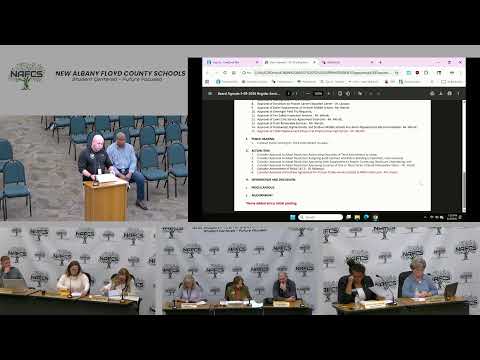
The New Albany-Floyd County school board voted to table consideration of proposed changes to policy 016.7.3 on March 9 after more than an hour of public comment and board debate.
Parents and community advocates told trustees the proposed revisions risk reducing transparency and called for clearer notice and safeguards. "You build trust through transparency and communication," said Kate McLean, a parent, urging the board to post draft policy language and contact information more visibly on the district website. Susan Pittman, speaking for the Protect Public Education Committee of Do Something Southern Indiana, urged adoption of Option B—"a clear improvement," she said—because it creates separate public-comment periods for agenda items and for general educational matters and cites guidance from the Public Access Counselor.
Under Option B, speakers who wish to address agenda items would sign up as now; a separate general-comment period at the end of the meeting would allow same-day sign-ups for broader educational topics. Board members debated whether individuals should also have a clear route to request agenda placement, how broadly "educational matters" should be interpreted, and what safeguards should limit the presiding officer's discretion to interrupt remarks.
Community member Chris Miles urged broader engagement and proposed a town-hall format for deeper dialogue about district spending and transparency. Katherine Collings, also with Do Something Southern Indiana, asked how the district will ensure consistency and avoid viewpoint discrimination when deciding what qualifies as an "educational" matter.
Board members disagreed about the mechanics of the edits and whether the board or its president should have authority to decide whether a requested item becomes an agenda item. Several trustees said they wanted time to process suggested changes and to reconcile Option A and Option B language. After discussion, a motion to table further action passed 6–1; the board said it will return to the policy at its next regular meeting with proposed final language and edits for a vote.
The board also discussed enforcement: several trustees said that if a speaker violates rules and is cut off, the board should not yield additional time to that speaker. The meeting record shows the board instructed staff to bring refined language and highlighted concerns to be addressed in the revised draft.
The board has not yet adopted a final version of policy 016.7.3; trustees scheduled continued consideration at the next regular meeting.