Get Full Government Meeting Transcripts, Videos, & Alerts Forever!
Get email alerts on the Conservation Districts topic
No spam. Unsubscribe anytime.
Conservation districts ask Michigan subcommittee for $13 million to stabilize operations and retain staff
Summary
Rivka Hodgkinson told the House appropriations subcommittee that $13 million in annual operational funding is needed so every conservation district can afford a full-time manager and technical assistance staff, arguing current $3 million state support yields a high return and that turnover undermines program delivery.
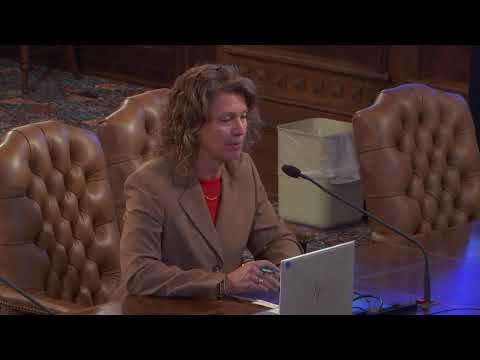
Rivka Hodgkinson, executive director of the Michigan Association of Conservation Districts, told the House Appropriations Subcommittee on Agriculture and Rural Development and Natural Resources that the state should provide $13 million in annual operational funding so every district can afford a full-time manager and a technical-assistance staffer.
Hodgkinson said conservation districts are “the workhorses of natural resource protection and agricultural development” and that a steady $3 million state investment over recent years has been leveraged to support roughly $78 million in state and federal programs statewide. “For only a $3 million investment by the state,” she said, “we had a 7 to 1 return,” and the current $40,000 per district allocation has reached the limit of what it can accomplish.
The request would raise per-district capacity to finance a full-time manager, an administrative employee and a technical-assistance position, Hodgkinson said, enabling districts to retain experienced staff and pursue additional federal and private grant dollars. She noted that districts ran about 1,547 voters in a recent local election in Ottawa County and held nearly 2,500 outreach events across 75 districts in recent years—evidence, she said, of community engagement that requires stable funding.
During questioning, Rep. Matt McKinney expressed support for strengthening Michigan’s competitiveness with other Midwestern states and said he backed efforts to find funding. Rep. O’Neill asked how staffing volatility affects farmers’ willingness to work with districts; Hodgkinson replied that turnover erodes relationships and slows program implementation, citing CTAP technician grants that expire Sept. 30 as an example of short-term funding that jeopardizes continuity.
Hodgkinson framed the $13 million ask as a way to match neighboring states’ investments—she cited state-level ranges from roughly $8–20 million in peer states—and to ensure Michigan can both accept incoming federal regenerative-agriculture dollars and maintain local technical capacity to put those dollars to use.
No formal action on the funding request was taken at the hearing. The subcommittee approved routine minutes and later adjourned; any change to the budget would require follow-up in the full appropriations process.