Get Full Government Meeting Transcripts, Videos, & Alerts Forever!
Get email alerts on the Data Center Moratorium topic
No spam. Unsubscribe anytime.
Sheboygan council refers proposed data-center moratorium to Plan Commission after public input
Summary
After sustained public comment urging stronger limits, the Sheboygan Common Council voted 7–3 on May 4 to refer a proposed temporary moratorium on data-center permits (ordinance No. 12627) to the City Plan Commission for further review and recommendations.
The Sheboygan Common Council voted 7–3 on May 4 to refer General Ordinance No. 12627 — a proposed temporary moratorium on zoning and building permits for data centers — to the City Plan Commission for initial review.
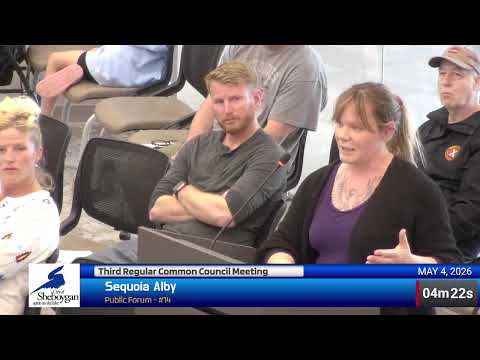
Residents who spoke during public comment urged a broader, stricter pause than the draft before council. Lisa Salgado said the moratorium should cover an entire project — “including the buildings, generators, cooling systems, batteries, substations, water use and wastewater needs” — and should bar related city actions such as land sales, development agreements, tax incentives and infrastructure promises while the city drafts rules. Mary Lynn Donahue, who identified herself as City Clerk, said a 12‑month moratorium would give officials time to study long‑term financial risks and avoid leaving communities with “stranded assets” that shift costs to ratepayers.
Several speakers, including Peter Jacobs, urged the council to base any threshold on electricity consumption rather than square footage; Jacobs recommended a 20‑megawatt threshold as a more accurate measure of potential environmental and utility impacts.
Council debate focused on procedure and scope. Alder Heideman said council members had heard mostly one side of the issue and urged gathering information from both proponents and opponents before acting. Alder Gravine and others described a moratorium as a pause to ‘‘give us time’’ to gather expertise, weigh impacts and consider zoning code changes; city staff and the city attorney said statutory process will start with the Plan Commission, which can hold hearings and return recommendations to council.
The motion to refer the ordinance to the City Plan Commission passed on a roll call vote (seven in favor, three opposed). Council members and staff said the Plan Commission phase will determine public‑hearing procedures and whether to recommend changes to the draft (including the 10,000‑square‑foot threshold currently in the draft). The council did not adopt the moratorium at this meeting; any final ordinance would require subsequent action by the Common Council after Plan Commission review.
Next steps: The Plan Commission will consider the referral, set public‑hearing logistics and may return a recommended ordinance to the Common Council for adoption, amendment or rejection.