Get Full Government Meeting Transcripts, Videos, & Alerts Forever!
Get email alerts on the Parks Recreation topic
No spam. Unsubscribe anytime.
Parks director outlines master‑plan results; trails and preservation rank highest
Summary
Parks & Recreation Director Tim Street told the council the department’s master plan work includes more than 1,200 questionnaire touchpoints and a statistically valid Acuity survey of 405 respondents (margin of error <5%). Top resident priorities were trails, open space and amenities; Bryant Park pool was the top facility residents named for investment.
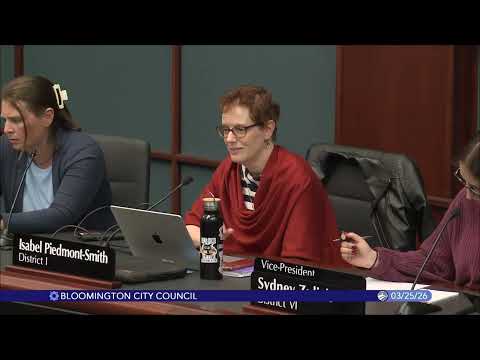
Tim Street, director of Bloomington Parks & Recreation, presented the department’s near‑final master plan at the March 25 council meeting, summarizing outreach and early findings.
Street said outreach included focus groups, community events and a questionnaire that drew "more than, I think, 1,200 responses" at places such as the farmers market, and a later statistically valid community survey run by Acuity that yielded 405 completed responses (weighted to match U.S. Census targets for Bloomington; margin of error reported below 5%). His summary of key findings: trails topped resident priorities (about 75% rate trails as a priority), followed by open space and natural areas (61%) and park and trail amenities (60%). Bryant Park pool was the most‑cited facility for investment.
Street outlined four draft goals for the next five years: meaningful community impact, investing in existing assets, financial sustainability and building a strong, connected staff. He said the Parks Board will receive the plan April 16 and the department hopes to complete adoption by its May meeting. He also highlighted program demand trends — farmers market, outdoor concerts and natural‑resources education drew high interest — and noted that facility investment preferences do not automatically equate to willingness to pay; survey responses measure sentiment, not committed funding levels.
Council members asked about ecological management in Griffey Lake Nature Preserve, deer‑population research and prescribed burns; Street confirmed the city is continuing its multi‑year deer hunt and conducts prescribed fires and plant censuses as part of ongoing natural‑resource monitoring.
The council received the update and asked for follow‑up details at future budget and board meetings.